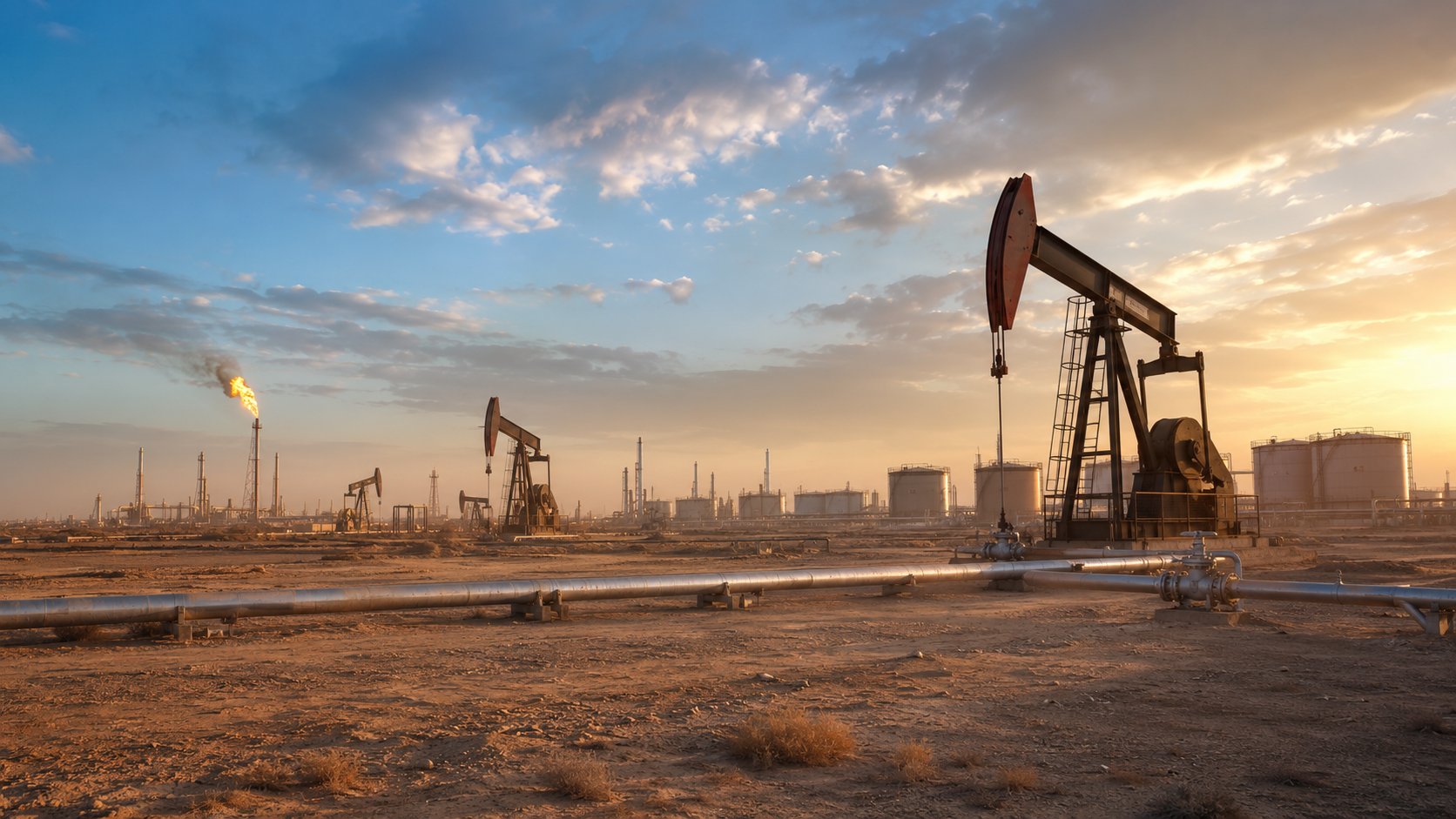
Iraq is forming a new package of cooperation with American energy companies, which should increase oil and gas production, accelerate the processing of associated gas and attract private capital to modernize the country's oil and gas infrastructure.
Iraqi Oil Minister Basim Mohammed estimated the total value of the deals between the Iraqi Oil Department and US companies at about $200 billion. According to him, the projects should significantly expand production capacity and increase investments in the use of associated gas. The current oil production capacity of Iraq is estimated at approximately 4.8 million barrels per day.
At the same time, the declared $200 billion should not be considered solely as the volume of already financed projects. The package includes contracts, preliminary agreements, memoranda, technical studies and potential investment programs, the final parameters of which will be determined based on the results of the negotiations.
During the visit of Iraqi Prime Minister Ali Faleh al-Zaidi to the United States, the Iraqi delegation held negotiations with representatives of Halliburton, Shell, Honeywell, Weatherford and Baker Hughes. The parties discussed the development of oil and gas fields, the introduction of modern technologies and the improvement of the efficiency of the energy sector.
Separate negotiations were held with Chevron. Iraq offered the company to expand operations in the southern fields, to participate in oil refining, petrochemical and gas infrastructure projects.
Chevron, for its part, expressed interest in developing the southern fields, laying pipelines to regional ports and creating oil storage facilities. The Iraqi authorities have declared their readiness to accelerate the allocation of land plots, the issuance of permits and the creation of the necessary infrastructure.
Halliburton received a contract from Basra Oil Company for the provision of integrated management services for the Bin-Umar and Sindbad fields in southern Iraq. The agreement provides for integrated management of asset development, as well as support for design, procurement and construction of infrastructure.
In fact, Iraq seeks to move from individual service contracts to the long-term presence of American companies in mining, refining, oil service, digital field management and construction of export infrastructure.
For Baghdad, American capital is important not only as a source of financing. Large US companies can provide access to technologies for increasing oil yield, modern drilling and compressor equipment, automation of production processes and international standards of project management.
Diversification of export routes becomes an additional task. Iraq is interested in developing pipelines, oil storage facilities and new access to regional ports to reduce dependence on a limited number of supply routes.
What opportunities open up for Ukraine
The scale of Iraqi projects creates opportunities not only for American operators. A significant part of the work will be carried out by international EPC contractors, oil service companies and equipment suppliers, which form their own global procurement chains.
For Ukrainian companies, the most realistic path is not the independent development of oil fields, but participation in projects as suppliers, engineering partners and subcontractors of American operators.
One of the main directions may be pipe and metallurgical products. Projects for the development of deposits and the construction of export infrastructure will require casing, pump-compressor and main pipes, sheet metal, tanks, metal structures and elements of industrial buildings.
Ukrainian manufacturers could also supply pumping and compressor equipment, shut-off valves, electric motors, transformers, cable products, distribution devices and modular substations.
A separate niche is related to processing accompanying gas. Iraq needs gas gathering networks, compressor stations, gas purification and preparation facilities, small power plants and power transmission equipment. American agreements provide for an increase in investments specifically in gas projects.
Ukrainian engineering companies can participate in the design of pipelines, tank farms, compressor and pumping stations, industrial facilities and energy supply systems.
Prospects also exist for the IT sector. It is about the implementation of SCADA systems, automated oil and gas accounting, digital modeling of fields, monitoring of equipment condition and industrial cyber security.
Another direction can be technical diagnostics of pipelines, protection of metal from corrosion, inspection of existing infrastructure and preparation of projects for its modernization.
The development of the oil and gas sector will create demand in related industries as well. The construction of industrial facilities will require cement, road materials, specialized machinery, mobile buildings, warehouse equipment, water supply systems and transport logistics.
Ukrainian food producers can get additional opportunities. Large projects are accompanied by the creation of worker villages, logistics centers and new service enterprises, which increases the demand for flour, vegetable oil, poultry meat, cereals and ready-made food products.
A tripartite model may be optimal, in which an American company acts as an operator or general contractor, a Ukrainian company supplies equipment, materials or engineering solutions, and an Iraqi partner provides registration, local logistics and interaction with state structures.
Working through American operators and international EPC contractors enables Ukrainian enterprises to obtain more transparent technical requirements, safety standards and quality control procedures.
At the same time, Ukrainian companies will need to undergo preliminary qualification of suppliers, confirm compliance of products with API, ASTM standards or the requirements of a specific customer, prepare English-language technical documentation and provide equipment service support.
For a systematic entry into the market, it is advisable to form a separate catalog of Ukrainian manufacturers of oil and gas and energy equipment. It should include production capacity, international certificates, export supply experience and willingness to work through American general contractors.
The next stage could be a three-way Ukraine-US-Iraq business mission with the participation of pipe manufacturers, power equipment, engineering and digital companies.
The most logical sites for such events are Baghdad, Basra and Houston, where Iraqi customers are concentrated, oil service companies and the main decision-making centers of the American energy industry.
The founder of the Experts Club information and analytical center Maksym Urakin, commenting on the structure of Ukraine's foreign trade, noted the need to transition to a more complex export model.
"Ukraine needs to increase not only the physical volumes of supplies, but also the share of products with high added value," Urakin emphasized.
For his estimate, to reduce the trade deficit, Ukraine needs to develop processing, engineering, food industry and technological exports.
Regarding Iraq, this strategy means a transition from mainly traditional commodity supplies to the export of pipes, metal structures, equipment, software solutions and engineering services.
Iraq is already a profitable market for Ukraine with a large positive trade balance. However, participation in energy and infrastructure projects would make it possible to make relations more long-term and increase the share of industrial products in Ukrainian exports.
According to the information and analytical center Experts Club, in January-June 2026, Iraq took the 53rd place in the ranking of the largest trade partners of Ukraine.
Trade turnover between the countries amounted to $151.123 million. Ukraine exported goods to Iraq for $151,051 million, while the import of Iraqi products amounted to only $72,000.
The positive trade balance for Ukraine reached $150,979 million. Thus, almost the entire bilateral turnover was formed at the expense of Ukrainian exports. The data is tabulated to the Experts Club analysis published on July 16, 2026.
For comparison, according to the results of 2025, Ukraine's trade with Iraq was estimated at $392,836 million. Ukrainian exports amounted to $392,513 million, imports - $323,000, and the positive balance reached $392,190 million.
Trade indicators confirm that Iraq remains a profitable sales market for Ukrainian companies. At the same time, the almost one-sided structure of trade indicates a low level of mutual investment and industrial cooperation.
New agreements between Iraq and the United States may become an opportunity to change this model. Even the limited participation of Ukrainian enterprises in energy projects with a total declared value of up to $200 billion can significantly increase the export of products with high added value.
With the proper organization of tripartite cooperation, Iraq can gradually transform from a predominantly commodity market into a long-term industrial, energy and infrastructure partner of Ukraine.