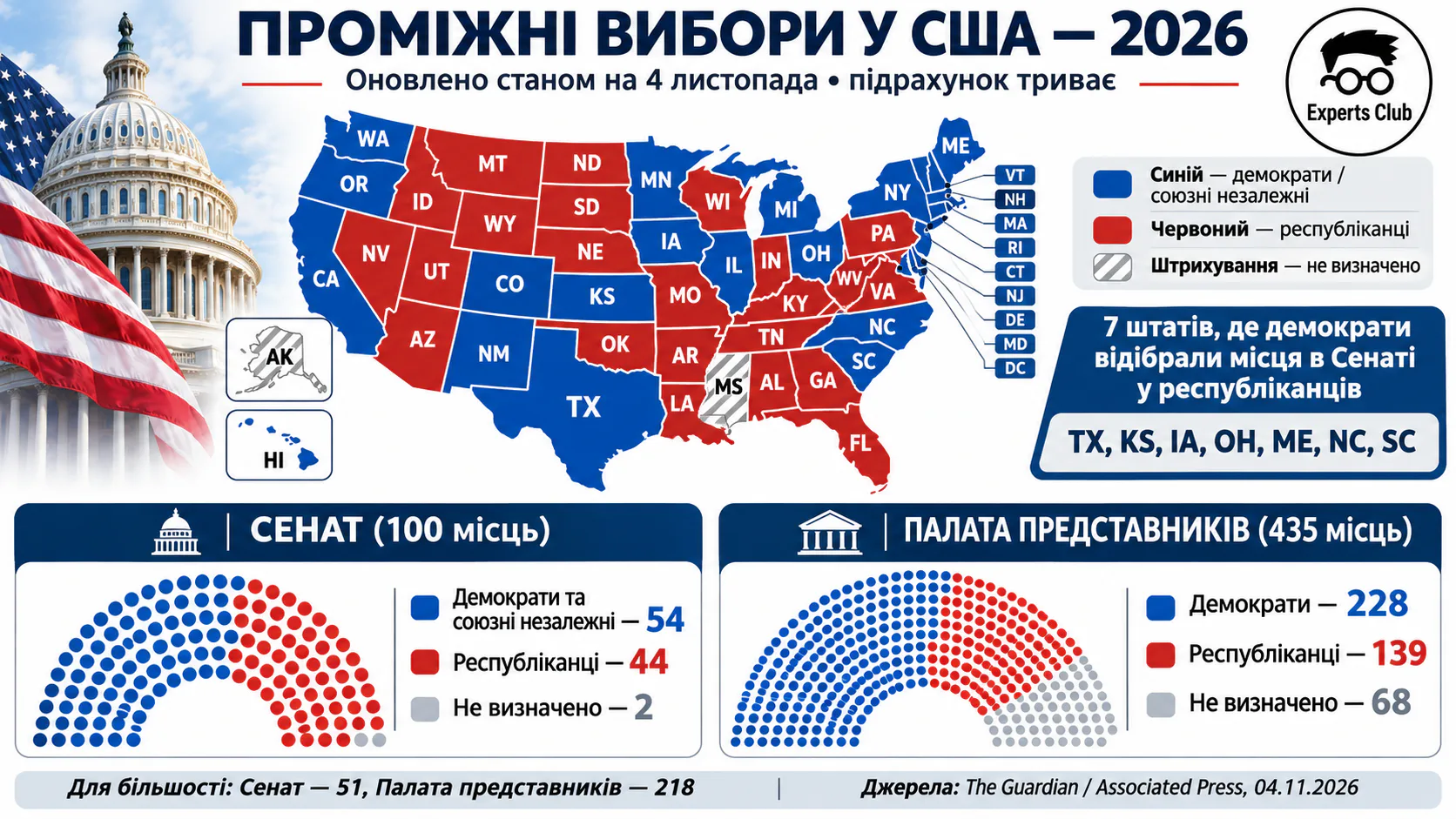
The U.S. Democratic Party, following the midterm elections of 3 November 2026, secured a majority in both chambers of Congress, ending a two-year period of Republican control over the legislative branch. However, the final distribution of all congressional and senatorial seats has not yet been determined, and official confirmation of the results in most states is expected in November-December.
Reuters and the Associated Press reported on 4 November that Democrats won not only in traditionally competitive states but also in several regions that had been Republican strongholds for decades.
In particular, the Democratic Party secured Senate seats previously held by Republicans in Texas, Kansas, Iowa, Ohio, Maine, North Carolina, and South Carolina.
Preliminary distribution of seats in Congress
According to data published 4 November by The Guardian's interactive election project, Democrats secured 228 seats in the House of Representatives, while Republicans secured 139.
At the time of the results update, winners had been determined in 367 out of 435 districts. Thus, the distribution of the remaining 68 seats was still undetermined.
To secure a majority in the House of Representatives, 218 seats are required, so the overall outcome of the battle for control of this chamber has already been decided.
In the Senate, Democrats and two independent senators who cooperate with the Democratic Party secured 54 seats against 44 for the Republicans. Winners were determined in 33 out of 35 senatorial elections held.
Thus, the final distribution of seats may still change, but the Democratic majority in both chambers has already been confirmed by leading American media outlets.
Key Democratic victories
One of the most notable results was the victory of Democrat James Talerico in the Senate election from Texas. For the first time in 38 years, the state elected a senator from the Democratic Party.
In Kansas, Democrat Adam Hamilton defeated the incumbent Republican senator Roger Marshall. This is the first Democratic victory in a senatorial election in the state since 1932.
In Ohio, the Senate seat was won by former Democratic senator Sherrod Brown. Democratic victories were also recorded in North and South Carolina, Iowa, and Maine.
The party also achieved success in gubernatorial elections.
In particular, in Texas, Democrat Gina Inohosa defeated the incumbent Republican governor Greg Abbott, in Georgia the gubernatorial election was won by Keisha Lance Bottoms, in Ohio by Amy Acton, and in Iowa by Rob Sand.
These results indicate a significant shift in electoral preferences compared to the presidential elections of 2024, when Donald Trump received the majority of votes in many of the listed states.
Why Republicans lost the majority
According to voter surveys conducted on Election Day, the main causes of American dissatisfaction were high cost of living, inflationary pressure, and the state of the economy.
The war with Iran, the trade policy of the Donald Trump administration, and concerns about the actions of the federal government also had a significant impact on electoral sentiments.
According to exit poll data conducted by SSRS for a group of American media outlets, nearly nine out of ten respondents named the cost of living as an important factor during voting.
About two-thirds of respondents blamed the high prices on the Trump administration.
Meanwhile, Democrats were able to increase support among moderate and independent voters and improve results in several districts where Republicans had previously won convincingly.
U.S. President Donald Trump, after the release of the initial results, acknowledged the Democrats' success and stated his willingness to cooperate with them on certain issues, although he also criticized candidates from his own party.
When will the final election results be available
Despite the fact that control of Congress has already been determined, the official procedure for counting votes is still ongoing.
In the U.S., there is no single date for nationwide certification of midterm election results. Each state independently completes the verification of ballots, review of disputed votes, possible recounts, and official confirmation of the results.
According to the election information project Ballotpedia, in 2026 four states will certify the results within the first week after the elections.
Another 25 states plan to complete the official procedure from 11 to 30 November, and 16 states and the District of Columbia in December.
In five states, the specific date for certifying the results is not fixed by law.
In particular, in Arizona the official count must be completed by 23 November, in Alaska the approximate date is 25 November, and California plans to publish certified results by 11 December.
In some cases, especially with a minimal difference in votes, the final determination of winners may be delayed due to additional checks and legal procedures.
Which results remain undetermined
As of 4 November, Associated Press has not determined winners in two senatorial races.
In Mississippi, Democrat Scott Colom and incumbent Republican senator Cindy Hyde-Smith showed nearly equal results. After processing approximately 96% of the votes, Colom's lead was only 43 votes.
No winner was determined in the Senate election from Alaska, where Republican Dan Sullivan and Democrat Mary Peltola were competing.
Vote counting also continued in several dozen House of Representatives districts and in some gubernatorial races.
To establish the final numerical advantage of Democrats, it is necessary to await the completion of these procedures.
What the Democratic victory means for the U.S. economy
The change in party control of Congress may significantly impact the economic policy of the United States in the next two years.
Democrats will gain the ability to block legislative initiatives of the president, influence the approval of the federal budget, tax changes, and expenditures of government agencies.
At the same time, Donald Trump will retain presidential powers, including the right to veto bills passed by Congress and significant authorities in the field of foreign policy and regulation of international trade.
Thus, the U.S. is transitioning to a model of divided government, where the president represents the Republican Party, and the majority in both chambers of Congress belongs to the Democrats.
According to financial analysts surveyed by Reuters 4 November, such a configuration may lead to a slowdown in the adoption of large-scale budgetary and tax initiatives.
Changes may also occur in regulatory policy regarding technology companies, artificial intelligence, and the cryptocurrency sector.
However, the actual consequences for financial markets will depend on the ability of the presidential administration and Congress to reach agreements.
What consequences are possible for Ukraine
The results of the midterm elections are significant for Ukraine as well, since the U.S. Congress participates in approving defense spending, budgetary financing of international programs, and decisions on providing foreign aid.
Democratic control over both chambers potentially expands their ability to influence the parameters of U.S. support for Ukraine, discuss new aid packages, and oversee their implementation.
At the same time, the election results do not mean an automatic change in Washington's policy.
The president retains significant foreign policy powers, so specific decisions regarding the Ukrainian direction will depend on the interaction between the White House and the new composition of Congress.
When the new Congress begins work
The new composition of the U.S. Congress will begin performing its duties 3 January 2027.
Until then, the current composition of the legislative body will continue to work.
It is expected that in the coming days, American media will determine the winners in most of the remaining electoral districts. However, to publish the fully confirmed distribution of all mandates, one must wait for the official completion of the vote count in the states.
Thus, as early as 4 November, one can state the main political consequence of the midterm elections: Democrats have gained control of Congress and significantly changed the balance of power in Washington.
At the same time, the final quantitative results of the elections will become known primarily in November-December 2026, after the completion of the procedures prescribed by law.