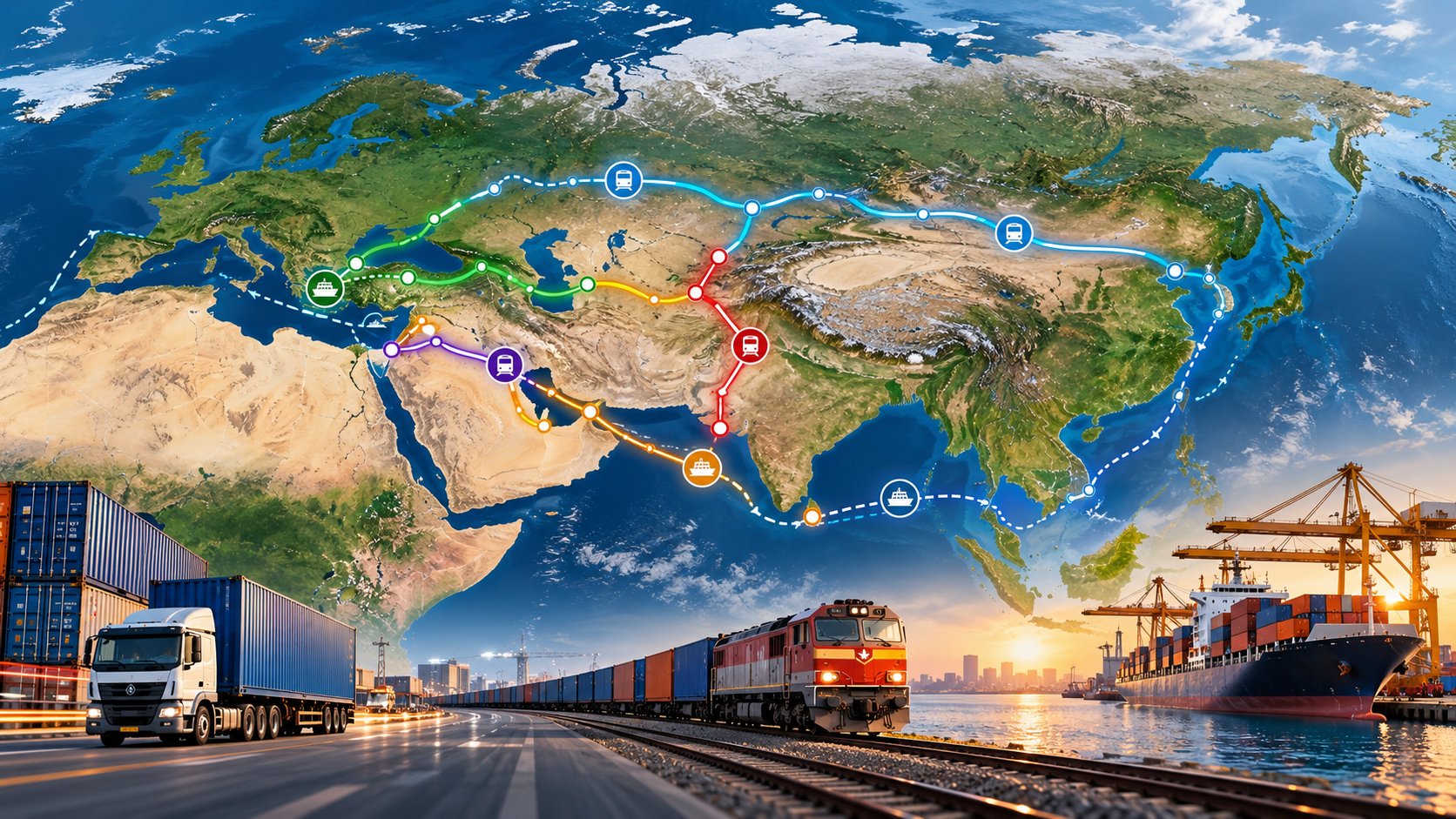
An extensive system of railway, road and sea corridors is being formed in Eurasia. The countries of Central Asia, the South Caucasus, Turkey and the states of the Persian Gulf seek to expand access to foreign markets and reduce dependence on individual transit routes. The economic outcome will be determined by the availability of financing, infrastructure consistency, competitive cost and estimated delivery times.
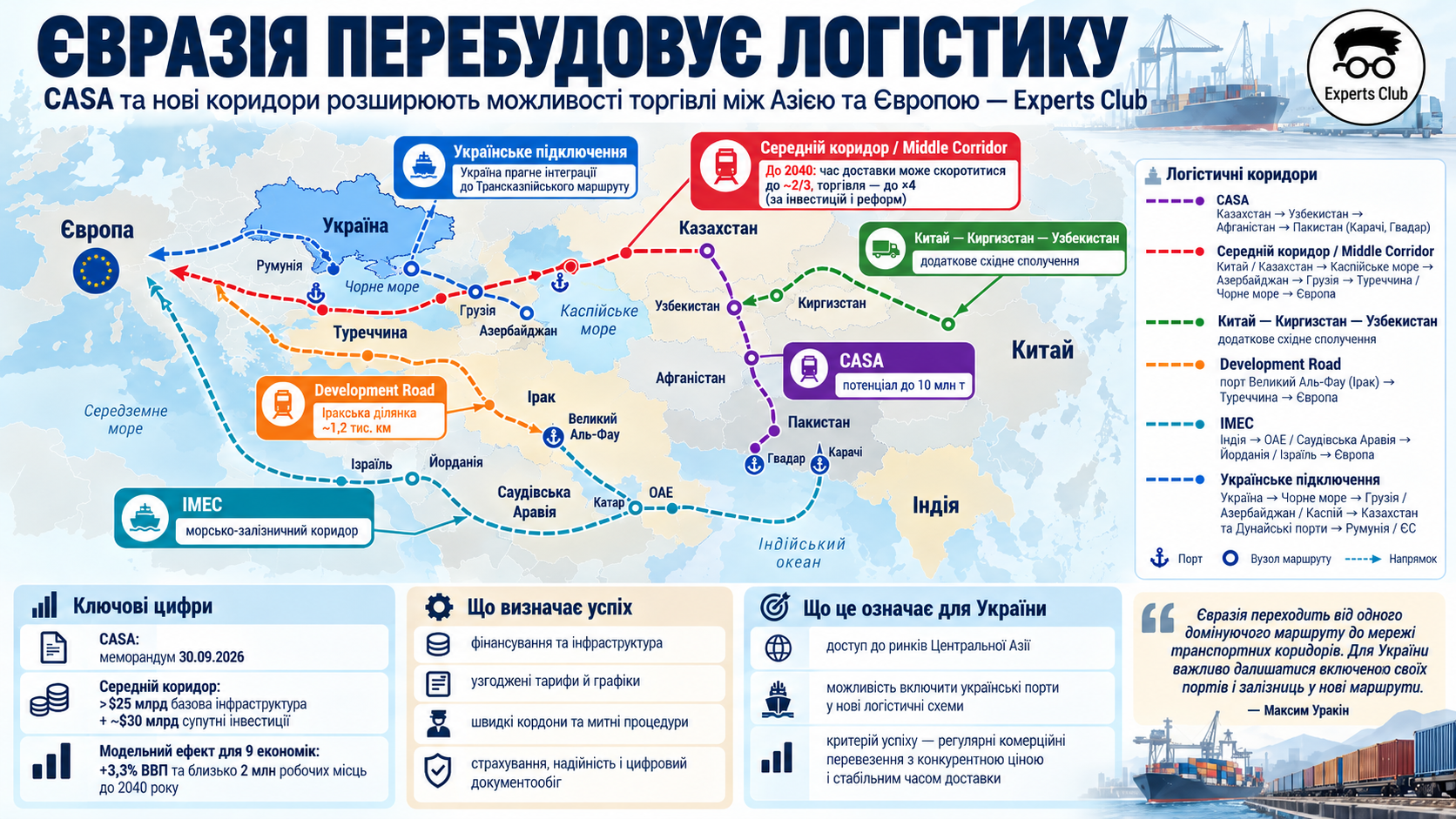
One of the potential elements of the new network is the Trans-Afghan Central Asia-South Asia Transport Corridor, or CASA. On September 30, 2026, the government of Kazakhstan announced a memorandum between the ministries of transport of Kazakhstan and Uzbekistan and the Ministry of Energy and Infrastructure of the UAE regarding the development of the railway route Kazakhstan - Uzbekistan - Afghanistan - Pakistan with access to Pakistani seaports.
The agreement provides for technical and economic studies, assessment of the necessary infrastructure and implementation mechanisms. The creation of a joint working group is still under consideration. The announcement did not include a final cost, an approved funding scheme or a launch date for the end-to-end connection. So, we are talking about the preparation of an investment decision, and the industrial and trade effects remain promising.
CASA's potential of up to 10 million tons of cargo in the direction of the ports of Karachi and Gwadar was estimated by the Deputy Prime Minister of Kazakhstan, Serik Zhumangarin, during the negotiations in Afghanistan, which the government announced on June 21, 2026. This figure characterizes the preliminary assessment of the possibilities of the corridor, and confirmation of future demand requires a separate study.
For Kazakhstan and Uzbekistan, the value of CASA lies in the creation of an additional north-south axis. Countries without direct access to the World Ocean can get another route to the Arabian Sea. The practical value of such a connection will depend on the full cost of delivery to the port: railway fare, transshipment, insurance, crossing borders and the reliability of further sea service.
The participation of the UAE in the development of the project potentially expands the range of investors and logistics partners. However, the memorandum itself does not mean that the Emirates have already taken over the financing of the construction.
Middle Corridor: Investments must be accompanied by changes in the organization of transportation
The Trans-Caspian international transport route, known as the Middle Corridor, already combines rail and sea transportation. Its main axis passes through Kazakhstan, the Caspian Sea, Azerbaijan and Georgia, from where cargo can go via Turkey or the Black Sea to European markets. This is one of the key areas of diversification of connections between Asia and Europe.
On September 28, 2026, the World Bank presented the study Integration: World-Class Trade Logistics Along the Trans-Caspian Transport Corridor. According to his scenario estimates, infrastructure investment could more than triple trade volumes along the route and halve transit times by 2040. Combining investment with reforms to trade and transport procedures could deliver a four-fold increase in volumes and cut delivery times by around two-thirds compared to 2023.
The bank also estimates the possible effect of increasing GDP by 3.3% and creating about 2 million additional jobs by 2040. This is a model result for the nine economies of Central Asia, the South Caucasus and Turkey, and not the annual GDP growth of each state of 3.3%. The effects will be different for them; Armenia is included due to the expected future transport connectivity.
The scale of the investment required explains why these results remain tentative. The World Bank estimates the need for basic infrastructure at more than $25 billion by 2040, and additional connections, terminals, equipment and other related investments at about $30 billion. The development of the corridor requires the simultaneous removal of restrictions on railways, ports and sea crossings.
Some of the projects already have specific financial mechanisms. On February 19, 2026, the World Bank approved an IBRD guarantee of $846 million to attract $1.41 billion in long-term commercial financing of Kazakhstan's railway infrastructure. The package also includes a co-guarantee of the Asian Infrastructure Investment Bank for $564 million. The guarantees cover the financing involved: adding all three amounts as separate investments is incorrect. The project covers the new Mointa-Kyzilzhar line with a length of 322.3 km, which should shorten the route by 149 km.
In June 2026, the EBRD announced a loan of up to €230 million in the equivalent of Japanese yen for the completion of the modernization of the 234 km Aktobe-Ulgaysin highway. This is the second part of the bank's financing of the corresponding project, which is co-financed by the Asian Infrastructure Investment Bank. The site belongs to the direction Western Europe — Western China.
The benefit of a faster train may disappear due to waiting for a ship or a delay at the border. Therefore, the return on the new track depends on the coordination of schedules, port capacities and transit procedures.
China — Kyrgyzstan — Uzbekistan: additional eastern connection
The China-Kyrgyzstan-Uzbekistan railway should create an additional exit from the western regions of China to Central Asia. On July 16, 2026, the Dunyo agency, citing the Ministry of Transport of Uzbekistan, reported that the parties to the negotiations with the China State Railway Group assessed the construction as meeting the established schedule. The competitiveness of the already existing multimodal route through Kyrgyzstan was discussed separately. Current combined transportation and the construction of a new railway are different stages of the development of the connection.
For Uzbekistan, the combination of an eastern route with access through the Caspian to the west and a potential trans-Afghan route to the south expands transport options. The country can strengthen its role in cargo consolidation, warehousing logistics and serving regional trade. However, a geographic intersection becomes an economic hub only if there is regular demand and effective services.
According to official data of Uzbekistan, by the end of 2025, the operational length of railway tracks for general use was about 4.7 thousand km, while the total length of tracks, including departmental tracks, was about 6 thousand km.
Development Road: connecting the Persian Gulf with Turkey and Europe
The Iraqi Development Road, or "Development Road", provides a rail and road connection from the port of Great Al-Faw in the south of Iraq to Turkey and on to the European transport network. The Iraqi part of the corridor should stretch for approximately 1.2 thousand km. The Turkish side plans to integrate it with its infrastructure and exits to the ports of the Black, Mediterranean and Aegean seas.
Iraq, Turkey, UAE and Qatar signed a quadrilateral memorandum on the project on April 22, 2024. During the September 23, 2026 meeting in New York, the leaders of Turkey and Iraq reaffirmed their intention to accelerate joint strategic projects, including the Development Road.
The benchmarks of 4.7 million TEU container and 28.5 million tons of bulk cargo per year were indeed announced by the Ministry of Transport and Infrastructure of Turkey, but back in October 2023. These are the initial design parameters, and not the actual throughput of the existing through route. TEU means the equivalent of one twenty-foot container.
Implementation of the project requires agreed deadlines for the readiness of the port, railway, highways and border crossings. Completion of one facility will have limited effect if other links remain underprepared.
IMEC: political support and complexity of end-to-end logistics
The India-Middle East-Europe Economic Corridor, or IMEC, also involves a combination of sea and rail transport. The 2023 memorandum outlines an eastern route between India and the Persian Gulf and a northern route between the Gulf and Europe. India, UAE, Saudi Arabia, Jordan, Israel and European countries are named in the planned transport network.
India, USA, Saudi Arabia, UAE, EU, France, Germany and Italy became participants in the initial agreement. On June 17, 2026, the President of the European Council, Antonio Costa, after a meeting with the Prime Minister of India, Narendra Modi, confirmed the intention to jointly promote IMEC. At the same time, the initial memorandum defined political intentions and did not directly create international legal obligations.
IMEC's prospects depend on the ability to organize stable transit through several states and coordinate the work of sea and land sections. Additional overloads create costs, so the advantage of the route will have to be proven by full price and reliability of delivery. Regional security risks can affect both the movement of goods and the willingness of investors to finance the missing infrastructure.
The participation of the UAE in IMEC, Development Road and the preparation of CASA gives reasons to consider their policy as a diversification of logistics and investment links, which allows working with several flows and markets.