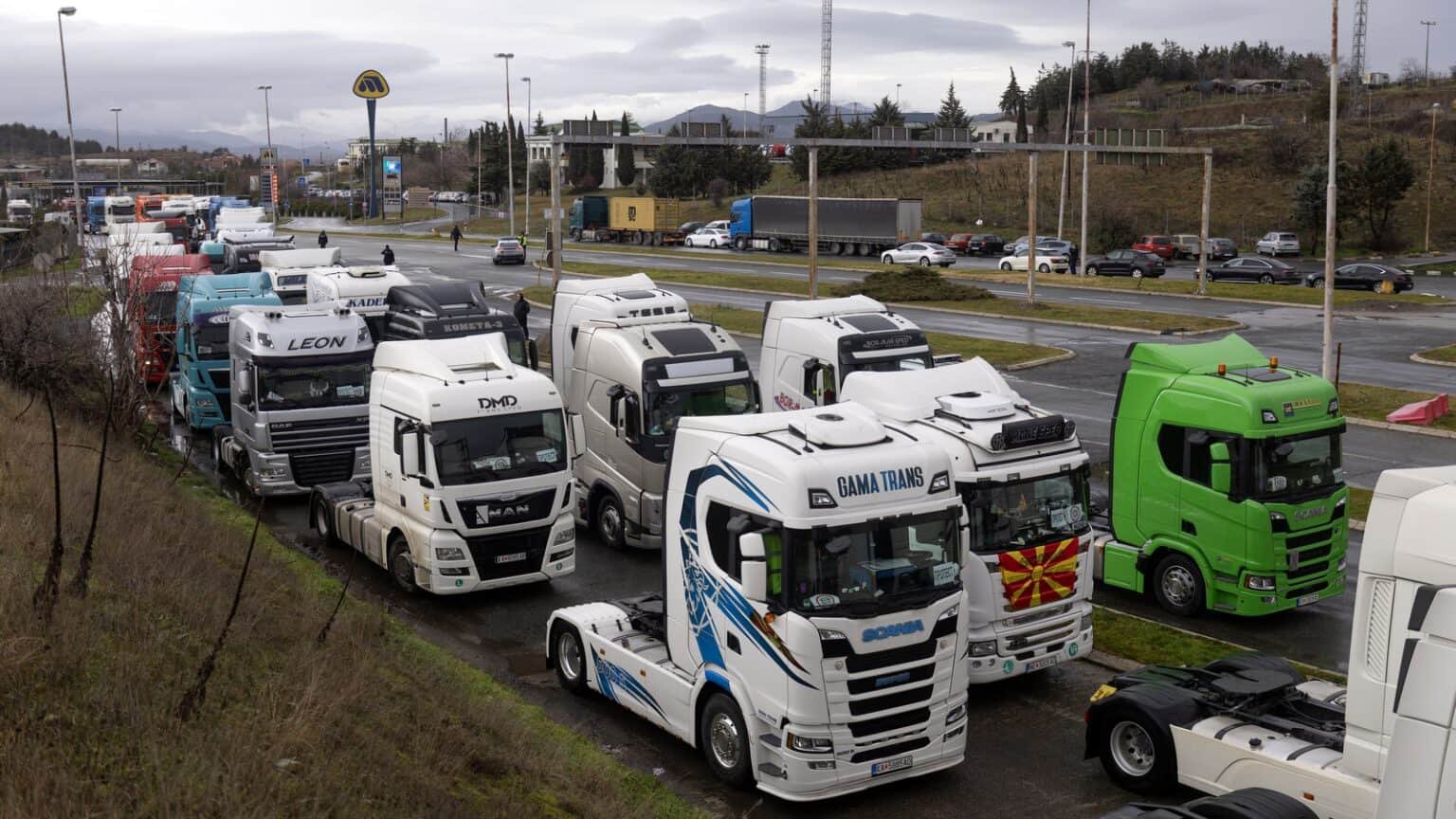
As reported by the Serbian business publication Parametar carriers officially confirmed the preparation of a new regional blockade of cargo transportation with the European Union. If a solution to the problem of professional drivers is not found during the remaining week, freight traffic is planned to be stopped at the borders of Serbia, Bosnia and Herzegovina, Montenegro and North Macedonia with the EU from 00:00 on September 14. The action is announced as open-ended - until an acceptable decision is made by Brussels.
In Serbia, the Association of International Road Carriers PUMEDTRANS is planning an action at 21 border crossings and transport points. The list includes, in particular, Batrovci on the border with Croatia, Horgos and Celebia with Hungary, Vatin with Romania and Gradina with Bulgaria. It is planned to stop the work of inbound and outbound cargo terminals at large crossings, and cargo traffic on access roads at small ones. At the intermodal terminal of the port of Novi Sad, there is a controlled passage of transport.
And this is not just a threat that sounded in the summer. After negotiations at the beginning of September, the carriers decided to hold an action. The European Commission made it clear on September 1 that it is not going to change the basic Schengen rule of 90 days of stay during any 180 days. Brussels recognizes the problem of drivers, athletes and other representatives of professions that require high mobility, but proposes to look for solutions within the existing rules - through long-term visas, residence permits, bilateral agreements or, in some cases, the status of a border worker.
For an international truck driver, every day of his stay in Schengen is counted in the same way as a tourist, even if he crosses Slovenia or Hungary for a few hours in transit. The EES system did not create this limitation, but electronic entry and exit accounting made it much simpler and tougher to control. This is confirmed by the European Commission.
According to Serbian carriers, for the normal operation of international the driver needs 120-130 days of stay in the Schengen zone per six months. PUMEDTRANS claims that dozens of Serbian drivers are already turning around at the borders every day, and the congestion in the region's car fleets due to the lack of available drivers could be reduced by about 50%. These are estimates of the industry association itself, not official EU statistics.
For Serbia, the risk is particularly high due to the structure of trade. In January–July 2026, the country's foreign trade turnover reached 46.6 billion euros, having increased by 6.3% over the year. EU countries accounted for 58.6%, that is, approximately 27.3 billion euros of trade in just seven months. On average, this corresponds to almost 129 million euros of goods turnover with the EU per day.
There is also a real guideline for possible losses. During the previous blockade in January, the head of the Chamber of Commerce and Industry of Serbia, Marko Chadezh, estimated the direct losses to the economies of the Western Balkans from the stoppage of exports alone at about 100 million euros per day. Reuters gave a close estimate at the time — about 92 million euros per day. The Chamber of Commerce also warned of fines for late delivery of components and products in the amount of 10–50 euros
The risk also exists in the opposite direction. A prolonged blockade will delay the import of equipment, components, chemical products, food and consumer goods to Serbia. However, a shortage of products in stores or fuel should not be expected after one or two days of blockade. Much more dangerous is the scenario in which the action will last a week or more.
Ordinary motorists are not going to formally block the border. But it is impossible to completely exclude problems for travelers. The German-Serbian Chamber of Commerce AHK has already warned about possible violations of both cargo and passenger cross-border traffic.
The planned September 14 blockade of freight traffic between Serbia, Bosnia and Herzegovina, Montenegro and North Macedonia with the European Union may partially affect Ukrainian carriers as well. At the same time, the very reason for the protest - limiting the stay of professional drivers in the Schengen area to 90 days within any 180 days - also applies to citizens of Ukraine, if they fly on the basis of visa-free regime and do not have another status that allows a long stay.
For the bulk of Ukrainian trade with the EU, the direct effect should be limited. The main road corridors from Ukraine pass directly through Poland, Slovakia, Hungary and Romania, and these Ukrainian-European transitions are not blocked by Balkan carriers. The protest does not directly affect the main route Ukraine - Romania - Bulgaria - Turkey, as well as the route to Greece through Romania and Bulgaria.
The situation is different with Ukrainian cargoes, the final destination of which is Serbia, Bosnia and Herzegovina, Montenegro, North Macedonia, Albania or part of the Adriatic region. For example, a truck from Ukraine to Serbia via Hungary must pass the Serbian-Hungarian border, where protesters plan to stop cargo terminals. A similar problem may arise on routes through Romania to Serbia, through Croatia to Bosnia and Herzegovina and Montenegro, as well as on the Bulgarian-Macedonian border.
At the same time, Ukrainian registration of the car will not guarantee the ability to drive. If the protest takes place in the declared format and the work of the cargo terminal or access road is physically stopped, the delay will apply to the flow of cargo as such, and not only to Serbian or Bosnian cars.
For Ukraine, its cause may be much more important than the Balkan blockade itself. Ukrainian international motor carriers are actually in the same legal category as carriers from Serbia, Montenegro or Bosnia and Herzegovina.
Citizens of Ukraine with biometric passports have visa-free access to the Schengen area, but the standard regime provides for a stay of no more than 90 days in any 180-day period. Ukraine is directly included in the list of visa-free third countries in the relevant EU regulation.
Moreover, on February 13, 2026, the Association of International Motor Carriers of Ukraine (ASMAP) separately reminded Ukrainian carriers about the 90/180 rule. The association recommended monitoring the dates of entry and exit to avoid fines or a ban on further entry into the Schengen area.
That is, a driver of a Ukrainian transport company who regularly travels, for example, from Ukraine to Germany, France, Italy or Spain, could theoretically face the same problem that Balkan carriers are now protesting about. The working day spent by kerm of a truck in Schengen, from the point of view of migration legislation, does not cease to be a day of stay in the Schengen area.
The problem became especially noticeable after the full launch of the European Entry/Exit System (EES). It did not introduce the 90/180 restriction - it existed before - but it automated the registration of entries and exits and the calculation of the length of stay. This is how the European Commission explained the situation surrounding Balkan drivers on September 1.
At the same time, Ukraine has a very important transport advantage over most of the countries of the Western Balkans. The agreement on road freight transportation between Ukraine and the EU, the so-called "transport visa-free", has been extended until March 31, 2027. It allows Ukrainian and European carriers to carry out bilateral and transit transportation without the traditional system of permits and has become an important part of the "Roads of Solidarity".
The situation is somewhat different for Ukrainians who legally reside in one of the EU countries. For example, temporary protection or a residence permit allows you to stay in the country that issued the corresponding document for more than the standard 90 days. But it also does not mean unlimited movement throughout the EU. The European Commission explicitly states that after receiving temporary protection in one state, a citizen of Ukraine can stay in other EU countries for up to 90 days within 180.
Thus, a Ukrainian driver who has temporary protection, for example in Poland, has no problems with long-term residence in Poland, but regular multi-week flights through Germany, France, Belgium, the Netherlands and other countries may still raise questions about the permitted length of stay outside the country accommodation.
Brussels itself has actually recognized the problem. In the first EU Visa Policy Strategy, published by the European Commission on January 29, 2026, international truck drivers are explicitly named among the professions that may need to stay in various Schengen countries for more than 90 days during the 180. The European Commission said that it will study the possibility of creating a new pan-European extended short stay regime for such professions. But as of the beginning of September, this is only a direction of the future reform, and not a valid exception.
Therefore, the Balkan conflict has significance for Ukraine far beyond the borders of transportation through Serbia. If the carriers of the Western Balkans manage to achieve a special regime for professional drivers at the level of the entire EU, Ukrainian international car carriers will have obvious reasons to demand the application of a similar mechanism to them.
Conversely, if the EU maintains the strict application of 90/180 without a pan-European professional exception, the problem may gradually become more acute for the Ukrainian road transport sector as well. This is particularly important, since road transport has become one of the key external channels after 2022trade of Ukraine: the European Commission estimated that after the implementation of the transport agreement, the volume of Ukrainian automobile exports to the EU increased by approximately two-thirds, and imports - by approximately 300,000 tons per month.
Regarding the blockade itself on September 14, the following scenario seems most realistic for Ukraine: 1-2 days of protest will be mainly local delays of goods related to the Balkans; a week-long blockade could already raise road freight rates in Southeast Europe, cause cars to be diverted and increase queues on alternative routes through Hungary, Romania and Bulgaria. If the protest drags on, the consequences may spread to industrial supply chains between Central Europe, the Balkans and Ukraine.