The Communist Party of China expelled 33 high-ranking officials and reshuffled its leadership
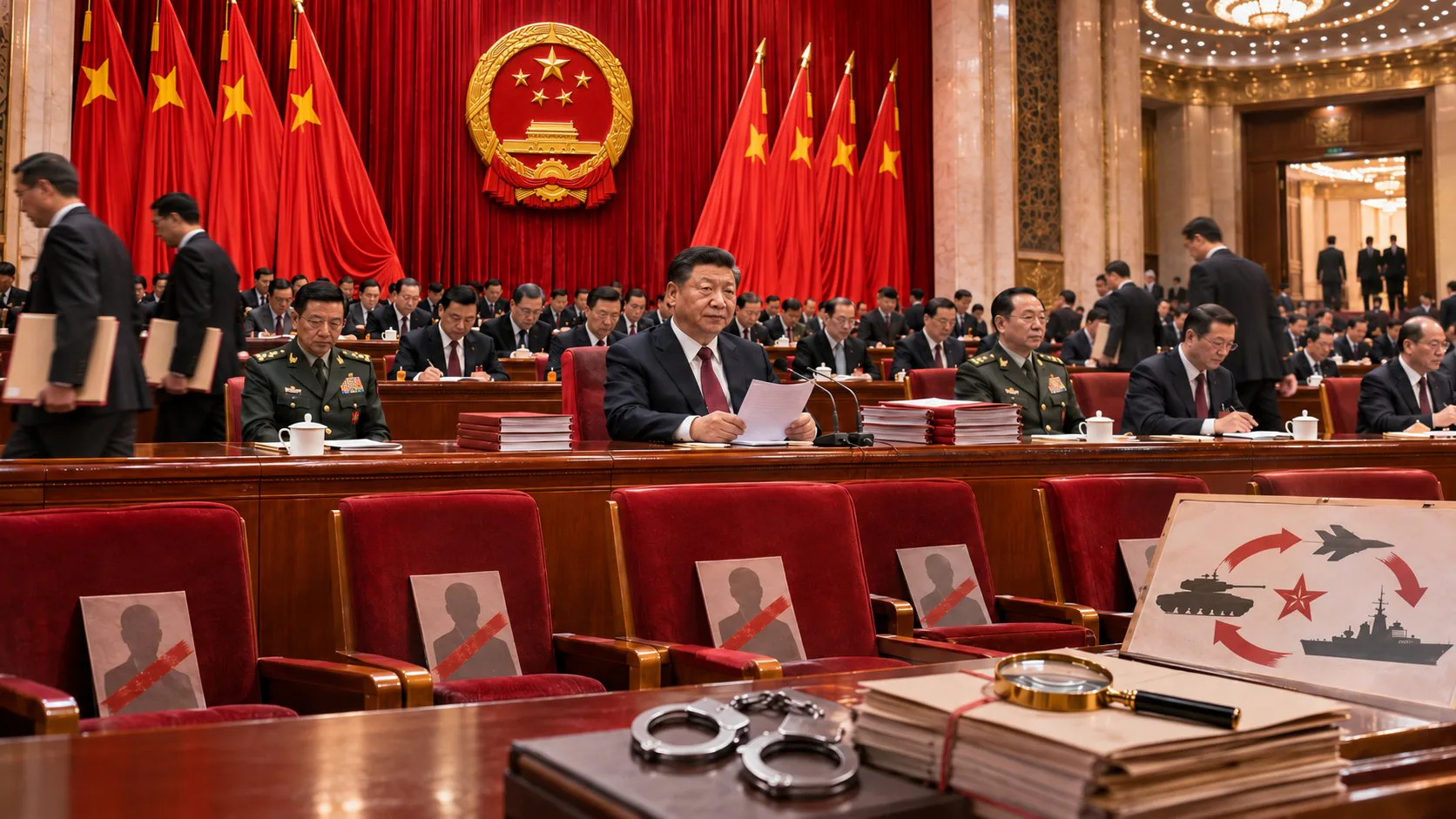
The Communist Party of China (CPC) approved the expulsion of 33 high-ranking officials, including 16 members of the military leadership, and carried out personnel changes in the party’s highest bodies. The decisions were adopted at the Fifth Plenary Session of the 20th Central Committee of the CPC, which took place October 26–29, 2026, in Beijing, chaired by Party General Secretary Xi Jinping.
According to an official communiqué published by the Chinese state news agency Xinhua on October 29, the plenum confirmed decisions previously adopted by the Politburo to expel officials accused of serious violations of discipline and the law from the party. At the same time, General Zhang Shengmin was elected to the Politburo, and ten candidates for membership in the Central Committee were granted full membership status.
The scale of the personnel reshuffle was one of the largest during the tenure of Xi Jinping, who has led the Chinese Communist Party since 2012. According to estimates by Reuters and other international media outlets, the current campaign is marked by a record number of expulsions and the lowest level of Central Committee member participation in a plenum since the era of Mao Zedong.
Who Lost Leadership Positions in the Chinese Communist Party
Among the most influential politicians whose expulsion was approved at the plenum was Ma Xingrui, a former member of the CPC Central Committee’s Politburo and head of the party organization in the Xinjiang Uyghur Autonomous Region.
Ma Xinzhui held an important position in the Chinese political system and was previously regarded as one of the promising members of the party’s top leadership.
Another significant personnel decision was the permanent expulsion from the party of General Zhang Yuxi, who served as vice chairman of the Central Military Commission of China. He was considered one of the country’s most influential military commanders and had long been part of Xi Jinping’s inner circle.
General Liu Zhenli, former chief of the Joint Staff of the Central Military Commission, was also expelled from the party.
The personnel decisions affected not only the security forces but also the leadership of the diplomatic, industrial, and financial sectors.
In particular, Liu Jianchao, former head of the International Department of the CPC Central Committee; Jin Zhuanglong, former Minister of Industry and Information Technology; and Yi Huiman, former chairman of the China Securities Regulatory Commission, were expelled.
A separate decision was made regarding Li Yunzhe, who previously headed the China Banking Regulatory Commission. Unlike the 33 officials who were expelled, he was stripped of his party posts, but the official communiqué does not mention his expulsion from the CPC.
Chinese authorities attribute these personnel decisions to violations of Party discipline and the law. However, official statements do not disclose details of all investigations, so it is impossible to determine, based on the published documents, to what extent individual cases are related to corruption, administrative violations, or political disloyalty.
The number of plenum participants fell by more than a quarter
The scale of the changes in the party leadership is also reflected in the statistics on plenum attendance.
According to an official Xinhua report, 162 full members of the Central Committee and 117 candidate members of the Central Committee—a total of 279 people—participated in the sessions held October 26–29.
By comparison, in 2022, when the party’s governing bodies were being formed, the corresponding membership totaled 376 people.
Thus, the number of participants in the current plenum was 97 fewer than the original composition, or approximately 25.8% fewer.
The previous plenum in October 2025 was attended by 315 members and candidate members of the Central Committee, and the one in July 2024 by 364.
However, the difference between the number of originally elected Central Committee members and the number of participants at the meeting does not mean that all those absent were expelled from the party. Some of the personnel changes are due to retirements, transfers to other positions, and other reasons.
However, international observers view the decline in plenum attendance as one indicator of the extent of the reshuffling within the CPC’s top leadership.
Ten New Members of the Central Committee
In addition to approving expulsions, the plenum decided to fill vacant seats on the Central Committee.
Ten candidates for Central Committee membership were admitted as full members of the governing body.
They included Lu Dongliang, Bao Gang, Xin Shanping, Qu Yingpu, Lv Jun, Zhu Tianshu, Zhu Guoxiong, Liu Jun, Liu Jie, and Liu Qiang.
This decision reflects the mechanism provided for in the party charter for replacing members of the Central Committee who have left.
At the same time, the plenum did not announce a large-scale filling of vacant seats on the Central Military Commission, despite a significant reduction in its membership.
According to experts, the formation of a new military leadership team will be one of the most important personnel issues ahead of the next Party Congress.
Why Xi Jinping Continues Personnel Shuffles
The fight against corruption has become one of the main pillars of Xi Jinping’s domestic policy since he came to power in 2012.
Over the past few years, disciplinary investigations have affected millions of party and government officials at various levels. In recent years, particular attention has been paid to the military leadership, state-owned enterprises, financial regulators, and regional leaders.
Chinese authorities assert that the anti-corruption campaign is necessary to ensure effective governance, strengthen party discipline, and eliminate abuses.
At the October plenum, a special resolution was adopted that calls for further strengthening of internal party controls, improving disciplinary procedures, and increasing the accountability of officials.
The document also calls for tighter oversight of the selection of senior officials and for countering informal decision-making mechanisms that could facilitate corruption.
International analysts view these developments within a broader political context.
According to their assessments, large-scale personnel reshuffles may simultaneously serve as a tool to consolidate Xi Jinping’s personal power, eliminate potential rivals, and ensure the loyalty of the leadership.
However, such interpretations remain analytical assessments. Official Chinese documents do not confirm the existence of a single, organized opposition center within the CPC leadership.
China Prepares for a Leadership Transition in 2027
The key political event of next year will be the 21st National Congress of the Communist Party of China, which is scheduled to take place in Beijing in the second half of 2027.
The Congress will determine the new composition of the Central Committee and other top party bodies, as well as the main political guidelines for the next five-year period.
International experts expect that Xi Jinping will seek to retain the position of General Secretary of the CPC for a fourth five-year term.
Such a scenario would mean a continuation of his leadership of the party beyond 2027 and a further consolidation of the political governance system established during his tenure.
However, no such decision has been made yet, and the new composition of the governing bodies will be determined at the congress.
Of particular importance will be the renewal of the Politburo, the Politburo Standing Committee, and the Central Military Commission.
Currently, a large-scale reduction in the number of high-ranking officials is creating additional opportunities for the advancement of a new generation of party and military officials.
At the same time, the absence of a publicly designated successor to Xi Jinping maintains uncertainty regarding the long-term mechanism for the transfer of power.
How Personnel Changes Could Affect China’s Economy and Foreign Policy
These reshuffles are taking place against the backdrop of a slowdown in China’s economic growth, persistent problems in the real estate market, trade disputes with the United States, and the need to accelerate technological modernization.
Of particular significance for economic policy is the fact that disciplinary investigations have targeted leaders in the industrial and financial sectors, as well as representatives of the largest state-run organizations.
Tighter control over officials may help combat corruption and increase transparency in governance. However, frequent personnel changes also create risks of slowing down decision-making and complicate the implementation of long-term programs.
The situation in the military is of particular importance.
China continues to modernize its armed forces, develop its navy and missile systems, and strengthen its defense capabilities amid tensions surrounding Taiwan and in the South China Sea.
A large-scale replacement of the senior military leadership could affect the coordination of defense programs and personnel continuity, although it is not yet possible to reliably assess its implications for the combat readiness of the Chinese military based on publicly available data.
For international partners, particularly European countries, the most critical issue is the predictability of Chinese policy and the stability of the decision-making system.
At the same time, the official conclusions of the plenum do not call for a revision of China’s foreign policy course or a change in its core economic priorities.
What the Shuffles in the Chinese Communist Party Mean
The October plenum demonstrated that the anti-corruption campaign, which began after Xi Jinping came to power, remains a central tool of the CCP’s personnel policy.
On the one hand, the country’s leadership continues a large-scale overhaul of the party and state apparatus, justifying it as necessary to strengthen discipline.
On the other hand, the dismissals and expulsions are targeting officials who previously held key positions and were considered part of the Chinese leader’s inner circle.
It is precisely this circumstance that distinguishes the current phase of personnel reshuffles from the initial period of the anti-corruption campaign.
The main feature of these developments is not only the scale of the expulsions but also the concentration of power in the hands of the remaining leaders, particularly within the military command structure.
The upcoming 21st CPC National Congress in 2027 is expected to reveal how the party leadership plans to fill the personnel gaps and establish a new governance system for the next political cycle.
The Communist Party of China was founded in 1921 and has been the ruling party of the People’s Republic of China since its establishment in 1949. The CPC Central Committee is elected by the Party Congress, which is typically held once every five years. Between congresses, key political decisions are made by the Politburo and its Standing Committee. Xi Jinping, General Secretary of the CPC Central Committee, has held this position since November 2012 and has served as President of the People’s Republic of China since March 2013.