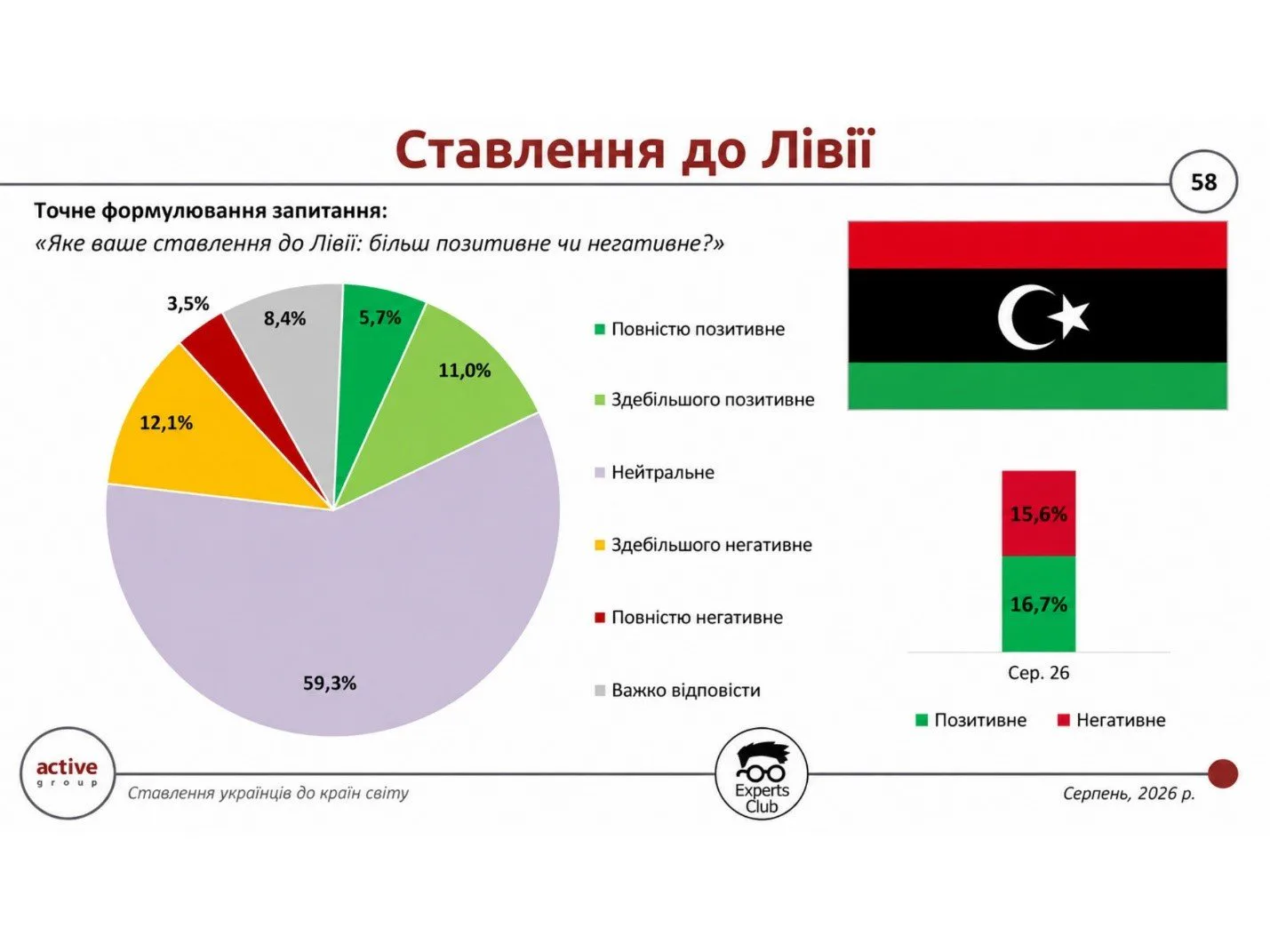
Ukrainians’ attitudes toward Libya in August 2026 remain predominantly neutral: 59.3% of respondents hold this view. 16.7% of those surveyed view the country positively, while 15.6% view it negatively, according to the Experts Club Information and Analytical Center. Experts.news
According to the survey results, 5.7% of Ukrainians have a completely positive attitude toward Libya, while 11% have a mostly positive attitude. 59.3% chose a neutral response. 12.1% expressed a mostly negative attitude, 3.5% a completely negative one, and another 8.4% were undecided.
Based on the rounded figures in the table, positive assessments exceed negative ones by only 1.1 percentage points. In the overall survey data, the balance regarding Libya is estimated at approximately plus 0.9 percentage points, which is one of the lowest positive results among the countries surveyed.
Thus, public opinion regarding Libya is effectively at a balance point: the positive and negative segments are nearly equal, but both are significantly lower than the neutral segment. If we add the 8.4% of respondents who found it difficult to answer, more than two-thirds of respondents do not express a clearly positive or negative attitude toward the country.
A similar pattern is characteristic of other North African countries. According to the results of the August survey wave, the share of neutral assessments in this region generally ranges from about 59% to 67%. At the same time, Egypt has a significantly more pronounced positive balance, Tunisia has a moderately positive one, while the figures for Algeria and Libya remain close to the neutral threshold.
At the same time, Libya is of practical importance for Ukraine’s foreign trade. Based on the results of the first half of 2026, it ranked among the top ten trading partners with whom Ukraine maintained a positive trade balance. This places it on par with such key export destinations as Egypt, Algeria, Lebanon, Tunisia, Iraq, and Yemen.
Oleksandr Pozniy, director of the research firm Active Group, noted that a high proportion of neutral responses does not necessarily indicate a lack of interest in a particular country.
“For Ukrainians, the world is not ‘black and white,’ and the high proportion of neutral assessments regarding a number of countries indicates caution and a desire for balanced judgment rather than indifference,” Pozniy noted, commenting on the results of a survey on Ukrainians’ attitudes toward international partners.
In the case of Libya, this point is particularly telling: 59.3% of neutral responses are accompanied by nearly equal proportions of positive and negative responses. This means that the public perception of the country in Ukraine remains underdeveloped, and future shifts in these assessments may depend to a large extent on media coverage, economic ties, and the development of bilateral relations.
The survey was conducted in August 2026 using an online self-administered questionnaire via the SunFlowerSociology panel among 800 Ukrainian citizens aged 18 and older. The sample is representative by age, gender, and region; the maximum theoretical margin of error for indicators at the 50% confidence level is ±3.5 percentage points.