More than 93% of Ukrainians support the humanitarian mission in Oleshky—according to an Active Group poll
A humanitarian mission to provide aid and evacuate civilians from the temporarily occupied town of Oleshky in the Kherson region is supported by 93.6% of Ukrainians surveyed, while 86.8% consider direct contact between Ukrainian authorities and the Russian Federation acceptable solely for the purpose of resolving humanitarian issues. These findings are based on the results of a public opinion poll conducted by Active Group.
The survey was conducted on October 31 at the request of the publication “Politarena.” According to the pollsters, 93.8% of respondents described the mission as important for Ukrainians who remained in Oleshky; specifically, 73% called it extremely important and 20.8% called it somewhat important. 77.4% of those surveyed fully support the delivery of aid and the voluntary evacuation of civilians, while 16.2% somewhat support it. 2.5% do not support the mission. Active Group Director Oleksandr Pozniy explained that the researchers were also interested in the public’s assessment of humanitarian agreements with Russia amid discussions on social media.
93.6% of Ukrainians surveyed support this, while 86.8% consider direct contacts between the Ukrainian government and Russia acceptable solely for the purpose of resolving humanitarian issues. This is evidenced by the results of a sociological survey conducted by Active Group.
The survey was conducted on October 31 at the request of the publication “Politarena.” According to the pollsters, 93.8% of respondents described the mission as important for Ukrainians who remained in Oleshky; specifically, 73% called it extremely important and 20.8% called it somewhat important. 77.4% of those surveyed fully support the delivery of aid and the voluntary evacuation of civilians, while 16.2% somewhat support it. 2.5% do not support the mission. Alexander Pozniy, director of Active Group, explained that the researchers were also interested in the public’s assessment of the humanitarian agreements with Russia amid discussions on social media.
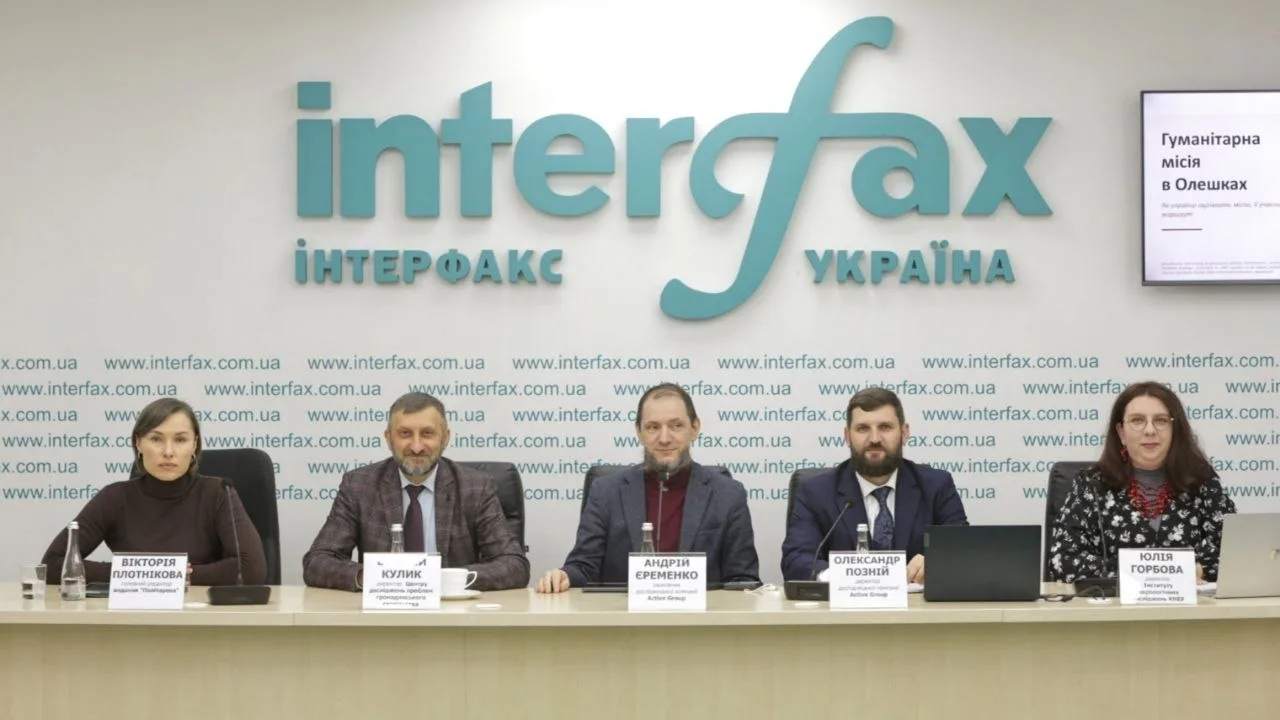
“We have seen time and again that the way social media and the online community reacted was very different from what Ukrainians actually thought. That’s why it was important for us to measure this difference to understand what Ukrainians really think,” he noted at a press conference at the Interfax-Ukraine news agency on Tuesday.
In turn, “Politarena” Editor-in-Chief Viktoria Plotnikova explained that the initiative to conduct the survey involved an unusual operational format, which included contacts between the Ukrainian and Russian ombudsmen, coordination of the route, and international mediation. In her view, the public reaction on social media did not reflect the attitudes of the majority of citizens.
“These processes are usually hidden, because we know that prisoner exchanges take place periodically, and the public hasn’t seen them. Now we’ve seen it, and this, of course, sparked a very emotional reaction among Ukrainians. But social media and the outrage on social media are very different from reality,” she emphasized.
A separate section addressed the role of U.S. First Lady Melania Trump in the agreements. She was viewed positively by 57.1% of respondents, of whom 29.7% viewed her very positively and 27.4% somewhat positively. A neutral assessment was given by 21.7%, a negative one by 5.7%, and another 15.5% stated they lacked sufficient information. Following reports of U.S. participation in the agreements, 20.3% of those surveyed said their opinion of the country had improved, 4.9% said it had worsened, and 66.5% said it had not changed. Another 8.3% were undecided. This reflects respondents’ self-assessment of changes in their attitudes, rather than a comparison of two independent measurements of the U.S. rating.
Andriy Yeremenko, founder of Active Group, attributed these assessments to the effectiveness of mediation.
“Such humanitarian efforts, if they are repeated and if they are truly effective, will increase trust, particularly in the U.S. A person who is safe is better off than a person who is in danger,” he noted.
The decision by Dmytro Lubinets, the Verkhovna Rada Commissioner for Human Rights, to personally join the mission was viewed positively by 61.3% of respondents, negatively by 3.3%, and neutrally by 23.5%; another 11.9% did not have sufficient information. After respondents learned of his participation, 29.6% said their attitude toward the ombudsman had improved, 4.2% said it had worsened, and 54.1% said it remained unchanged.
At the same time, 56.3% stated that the leader’s personal participation in a humanitarian mission generally increases trust in the organizers, 21.9% saw no impact, and 4.9% believed it reduces trust. Yeremenko explained that the presence of an official on the ground could have been an additional factor instilling confidence in people fleeing Russian control, although security guarantees and adherence to agreements remained critically important.
Regarding direct contacts between Ukrainian authorities and the Russian Federation solely for the purpose of providing humanitarian aid and rescuing civilians, 49.6% of respondents consider them absolutely acceptable, while another 37.2% consider them acceptable under clear conditions and oversight. 3.7% opposed such contacts, and 9.5% were undecided. The organizers emphasized that the question specifically concerned humanitarian cooperation, not political concessions by Russia.
According to Yeremenko, Ukrainian society has become more pragmatic in assessing the mechanisms for achieving results, without abandoning its fundamental demands regarding state policy. He cited among these principles the non-recognition of the occupation of Ukrainian territories, the preservation of defense capabilities, and preventing Russian influence on Ukraine’s sovereign decisions. Opinions remained divided regarding the evacuation route through Russian and Belarusian territory. Given that a direct route would require demining strategic areas and could weaken Ukraine’s defenses, 30.3% of respondents considered such a route acceptable, while 35.2% deemed it acceptable only with additional security guarantees. 11.1% called it unacceptable, while 23.4% reported that they lacked sufficient information to assess it.
“Organizing a corridor for a bus to pass through the front line means that demining must be carried out, and there is a risk of revealing certain concealed positions. These are potential problems for Ukraine’s defense. The main thing is to evacuate people, because that is the primary objective,” said Yeremenko.
Vitaliy Kulik, director of the Center for Civil Society Studies, called the operation a precedent, as the Ukrainian ombudsman took direct part in a humanitarian mission in the occupied territory. In his view, it demonstrated the possibility of personal diplomatic mediation in situations where traditional international mechanisms prove insufficiently effective.
“This is truly an extraordinary mission, as during wartime the ombudsman travels into enemy territory to rescue citizens. Typically, such cases in the history of conflicts have occurred through the mediation of international organizations. In this instance, no international organization was involved in carrying out the mission,” the expert stated.
Kulik suggested that the Oleshky experience could serve as a foundation for future humanitarian agreements, but emphasized the difficulty of repeating the operation. He also drew attention to the situation of the rescued people upon their return to territory controlled by Ukraine, particularly the need for document processing, social benefits, and support for elderly displaced persons.
“We rescued people, but what’s next? Those rescued from Oleshky are internally displaced persons. Sometimes, when people arrive in Ukraine, they face an insurmountable wall of bureaucracy,” Kulik emphasized.
Oleksandr Pozniy, for his part, explained that since 2023, Active Group has been conducting separate surveys among residents of the occupied territories, particularly in the Kherson region. According to him, residents reported difficulties with employment and access to medical care without a Russian passport, which underscores the importance of the evacuation.
Viktoria Plotnikova cautioned against excessive optimism regarding a repeat of the mission: in her view, its success was made possible by a convergence of political circumstances and the personal involvement of the parties to the agreements. She expressed hope for the continuation of humanitarian operations, while stressing that it is still too early to predict how regularly they will occur.
The Active Group survey was conducted via the SunFlower Sociology online panel among 1,000 respondents. The reported margin of error is ±3.1%. According to the company, the sample represents the adult population of Ukraine, excluding the temporarily occupied territories.