Intensification of Russian attacks on production, trade, logistics and digital facilities of Ukraine increases the losses of enterprises and limits the possibilities of sustainable economic growth of the country, the information and analytical center Experts Club notes. The destruction of large infrastructure nodes disrupts the operation of entire supply chains, increases the cost of production and forces companies to direct funds to restore and reserve capacity. Under such conditions, the ability of a business to continue its activities is combined with a decrease in its investment potential.
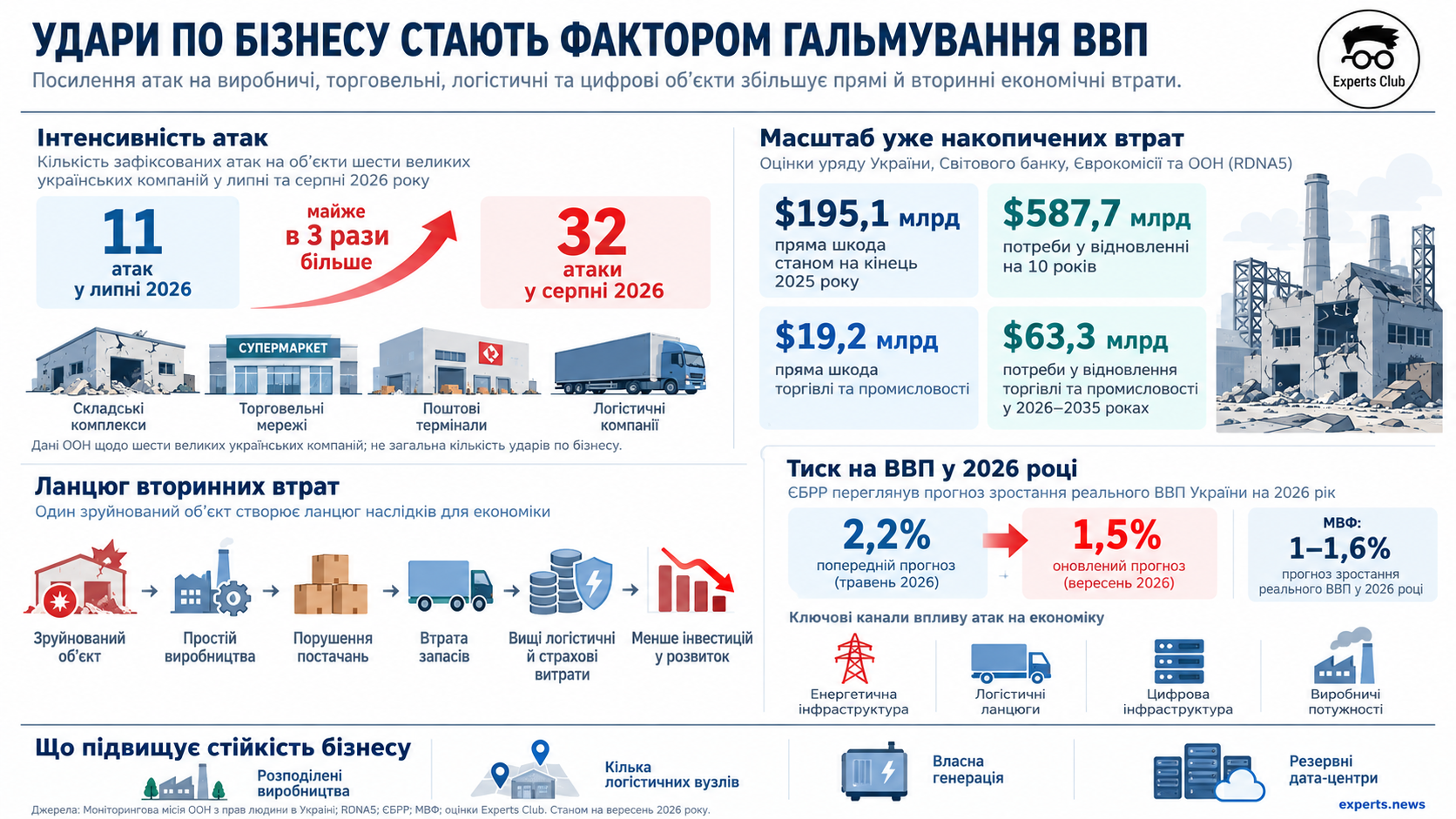
The scale of the threat is demonstrated by the data of the United Nations Monitoring Mission on Human Rights in Ukraine. In August 2026, the mission recorded at least 32 attacks on Fozzy Group, Epicenter, Novaya Poshta, Rozetka, Aurora, and Varus facilities, compared to 11 in July. This is almost a threefold increase within this group of companies; the indicator is not the total number of hits across the entire Ukrainian business.
Warehouse logistics became one of the most vulnerable areas. As a result of the attack on August 5, the largest Rozetka distribution complex in Brovary was destroyed. On the same day, NOVUS reported large-scale destruction and shutdown of its logistics center, and MTI Group lost its main DENKA LOGISTICS complex. The loss of such objects means a simultaneous violation of goods storage, order picking and delivery.
In August, the EVA chain lost its distribution center in Brovary. The co-owner of the company, Ruslan Shostak, estimated only real estate losses in the amount up to UAH 1 billion. On September 13, a Russian attack destroyed the EVA sorting center in Odesa, which supplied stores in the Odesa, Mykolaiv and Kherson regions. So the billion-dollar estimate was for a specific facility, not all of the network's wartime losses.
Fozzy Group reported more than 20 destroyed or damaged facilities between August 1 and September 25, including distribution centers, supermarkets and manufacturing facilities. From November 1, the group planned to reduce the number of employees of the group's office teams, "Silpo" and the logistics department. Previously, personnel changes took place in MAUDAU and IT departments. At the same time, the company continues to open stores and hire employees in supermarkets, warehouses and factories. This indicates a restructuring of costs and priorities to preserve operational activity.
On August 24, a Russian attack damaged two shopping centers "Epicentr" in Odesa. According to the company, as of August 23, since the start of the full-scale war, 11 of its hypermarkets have been destroyed, another 15 have been damaged, and two logistics centers and a ceramics factory have been destroyed. These cumulative indicators preceded the indicated attack on Odesa.
On August 31, a drone strike at the Novaya Poshta terminal in Odesa destroyed a key sorting line, which, according to the company, cannot be restored. The use of reserve routes allows to maintain delivery, but it requires restructuring of logistics processes.
On September 8, the Imperial Brands factory in Kyiv suffered significant damage. The company confirmed the destruction of production facilities and infrastructure, and on September 10, it informed NV Business about the halt in production. The term of its restoration at the time of the notification remained unknown.
On September 20, "EKO Market" reported damage to one of the warehouses, at the same time confirming the continued operation of stores. On September 25, a food warehouse with refrigeration chambers in Brovary district, which was used by a logistics partner of McDonald's, was attacked twice. The company said that restaurants continue to operate as usual. On September 27, the ZAMMLER group also reported that a warehouse in Kyiv region had been hit.
Digital infrastructure became a separate area of attacks. In September, data centers or equipment related to MiroHost, UTELS, Pavutyna, Domonet, Kievnet, Faust, and Datagroup were reported damaged. The consequences for customers were different: in particular, "Datagroup" announced the preservation of data and continued operation of services from backup platforms. This example demonstrates how early provisioning can reduce operational losses, although the costs of infrastructure restoration remain.
Experts Club founder, candidate of economic sciences Maksym Urakin believes that the economic consequences of attacks go far beyond the value of destroyed property.
“When a distribution center, factory or data center is destroyed, economic losses cannot be calculated only by the value of the object itself. Along with it, a part of production temporarily disappears, supplies of dozens or hundreds of other companies are disrupted, product stocks are lost, logistics and insurance costs increase, business is forced to create reserve capacities. Therefore, one physically destroyed object creates a chain of secondary losses for the economy," Urakin notes.
The scale of destruction was significant even before the latest wave of attacks. According to the joint assessment of the government of Ukraine, the World Bank, the European Commission and the UN RDNA5, published on February 23, 2026, the direct damage as of the end of 2025 amounted to $195.1 billion, and the needs for recovery during the next decade - $587.7 billion. In trade and industry, direct damage was estimated at $19.2 billion, about 85% of which fell on industry.
Estimated economic losses of this sector amounted to $232.9 billion. A methodological clarification is needed here: RDNA5 takes into account changes in economic flows during the assessment period and projected losses for an additional 18 months. Therefore, it is incorrect to call this amount exclusively the already incurred losses until the end of 2025. At the same time, the assessment of physical damage does not include new destruction in 2026.
To analyze GDP, it is also necessary to distinguish between the destruction of capital and the reduction of current production. The cost of a destroyed warehouse is not equal to an automatic reduction in annual GDP by the same amount. The impact is manifested through under-produced value added, downtime and reduced productivity. Restoration works can support current economic activity, but by themselves will not compensate for lost property and development opportunities.
Deteriorating conditions are already reflected in international forecasts. In the September review, the EBRD lowered the forecast for the growth of Ukraine's real GDP in 2026 from 2.2% to 1.5%. Among the reasons, the bank cited an increase in attacks on enterprises, energy infrastructure and Black Sea ports since July. Additional constraints remain labor shortages, weak business confidence and logistical difficulties.
The IMF, in its first review of the EFF program released on July 20, forecast growth of 1-1.6% in 2026. The fund attributed the worsening outlook to attacks on critical infrastructure and the negative externalities of war in the Middle East. This forecast preceded the events of August and September, so it does not reflect a separate assessment of their consequences.
The decrease in the EBRD forecast by 0.7 percentage points cannot be interpreted as an accurate assessment of the contribution of only business shocks: the revision covers a combination of factors. Data on the duration of downtime, the proportion of restored capacity, the replacement of suppliers and the amount of production transferred to other sites are needed to determine additional losses.
According to the Experts Club, the continued high intensity of attacks in the fourth quarter will increase the risks to industry, trade, exports and investment. Short stoppages compensated by spare capacity and long-term loss of production have different macroeconomic consequences. The speed of recovery of the entire supply network becomes decisive.
Enterprises are forced to simultaneously finance repairs, generators and storage of electricity, additional warehouses, backup servers and relocation of production. Such investments are necessary for business continuity, but with limited funding may crowd out investments in expansion and modernization. Higher costs partly reduce profitability, and partly can be transferred to prices, weakening purchasing power.
"Ukrainian business has demonstrated an extremely high ability to adapt in four and a half years. But economic stability does not mean the absence of losses. When a company builds a second reserve warehouse instead of a new factory, restores destroyed equipment instead of expanding production, and cuts staff instead of hiring new employees, formally the business continues to exist, but the potential for economic growth is reduced," notes the founder of Experts Club.
Additional risk arises for working capital. Companies can lose inventory that has already been paid for, while maintaining obligations to suppliers, banks and employees. Even in the presence of orders, the lack of liquidity can delay the recovery. For small suppliers, the problems of a large customer can turn into reduced sales and payment delays.
The consequences for employment are also heterogeneous: along with the reduction of certain functions, the need for repair and logistics work increases. However, workers are not always able to move quickly between professions or regions. For the budget, long downtimes create a risk of non-payment of taxes, while the need to finance recovery is growing.
A special role is played by energy and logistics, which depend on the activity of many sectors at the same time.
"The distribution center serves hundreds of stores, the terminal - thousands of shipments and companies, the data center ensures the work of many customers, the energy facility affects an entire industrial district at the same time. Therefore, the protection of energy, logistics and digital infrastructure today is not only a matter of security - it is already a direct tool for preserving GDP," Urakin believes.
The external economic effect can be manifested through a reduction in export revenue and an increase in the need to import equipment, fuel and goods to replace lost production. Freight forwarding takes time and additional costs. For exporters, this means pressure on profitability and the risk of losing contracts, especially when alternative routes do not provide the necessary throughput.
According to the Experts Club, it is advisable to combine the recovery with the decentralization of critical production, logistics and digital capacities. Support should also take into account access to revolving financing, war risk insurance and the speed of connection of reserve sites. The effectiveness of such measures should be evaluated by saved production, jobs and reduction of downtime.
Dispersal also comes at a price: multiple sites require additional personnel, equipment, and transportation costs. Therefore, decisions should be made taking into account the cost of possible downtime, availability of electricity and employees. Backup infrastructure must provide a real possibility to continue critical operations, and its readiness for work must be regularly checked, in particular under load.
"Ukraine will have to actually change its industrial geography. Large, centralized factories, warehouses, and data centers are cost-effective in peacetime, but become vulnerable in prolonged war. The next stage of business adaptation is distributed production, several logistics nodes instead of one, own generation, backup data processing centers and the ability to quickly transfer critical operations between regions," summarized Maxim Urakin.
According to RDNA5, the needs for the restoration of trade and industry for 2026-2035 amounted to $63.3 billion, including $25.4 billion for reconstruction. New destructions create additional needs, the final volume of which will also depend on the already completed restoration and clarification of estimates.
Experts Club is an information and analytical center that studies the Ukrainian and world economy, demography, foreign trade and industry markets. The founder of the center Maksym Urakin is a candidate of economic sciences.