The signing of the Mecca Joint Defense Agreement by Saudi Arabia, Turkey and Pakistan may be one of the most significant changes in the security architecture of the Middle East and South Asia in recent years, according to Experts Club analysts.
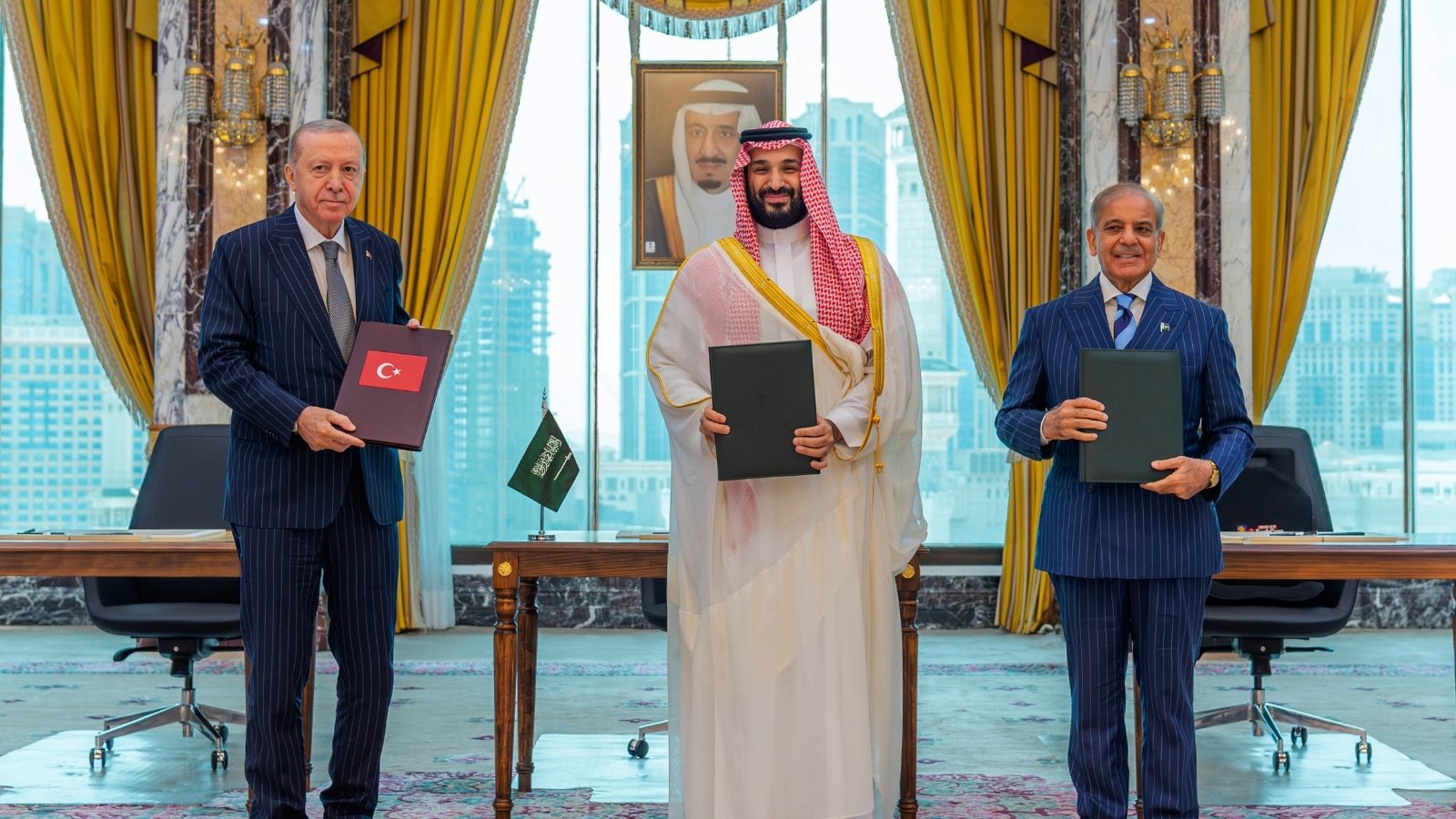
The agreement was signed on August 7, 2026 by Crown Prince of Saudi Arabia Mohammed bin Salman, President of Turkey Recep Tayyip Erdogan and by the Prime Minister of Pakistan Shehbaz Sharif after almost a year of negotiations.
The main principle of the document actually repeats the basic logic of NATO collective defense: an armed attack on one participant should be considered as an attack on all three.
Turkish Foreign Minister Hakan Fidan on August 8 directly compared this mechanism to Article 5 of the North Atlantic Treaty. At the same time, he emphasized that the agreement is not directed against Iran or any other specific country.
However, the political geography of the three participants makes it possible to single out several directions that could influence the creation of a new security mechanism.
The most direct factor in the formation of the alliance is Iran.
Saudi Arabia and Iran have been competing for influence in the Middle East for decades, despite the restoration of diplomatic relations for mediation of China. After a new escalation of the regional conflict in 2026, the security of Saudi Arabia, the oil infrastructure of the Persian Gulf, and the sea routes has again become a central problem for Riyadh.
Reuters associates the signing of the agreement precisely with the growth of regional instability and threats to the countries of the Persian Gulf. At the same time, Iran has already reacted to the creation of the new mechanism quite critically.
According to the Experts Club assessment, the containment of the possible expansion of the regional conflict around Iran should be considered the first function of the new agreement.
However, this does not mean the creation of a classic "anti-Iranian NATO". Pakistan maintains its own relations with Tehran and shares a common border with Iran, and Turkey is interested in maintaining economic and political channels of interaction with it.
Therefore, it is more profitable for all three states to formulate the agreement as a universal system of collective defense without naming the enemy.
The second direction is related to Israel.
The growing military independence of Israel and the expansion of its operations in the region cause concern not only in Iran, but and a number of Arab and Muslim states.
Reuters notes that the countries that are part of the agreement are concerned about both Iran's actions and Israel's military policy.
At the same time, the bloc's members' relations with Israel differ significantly.
Pakistan does not officially have diplomatic relations with Israel. Turkish-Israeli relations have repeatedly gone through periods of sharp aggravation in recent years. Saudi Arabia, on the contrary, has been considering the possibility of normalizing relations with Israel for a long time, although regional wars have greatly complicated this process.
Therefore, it is not about the preparation of an anti-Israeli military alliance, but about an attempt to create its own power center capable of limiting the unilateral dominance of any regional player.
The third direction is much more complicated - India.
For Pakistan, India remains the main long-term strategic a rival Both countries possess nuclear weapons, and the next major armed conflict between them took place in 2025. SIPRI separately notes that the India-Pakistan confrontation remains one of the factors of global nuclear risk.
Turkey has traditionally maintained close political and defense relations with Pakistan, and the differences between Ankara and New Delhi have repeatedly increased over Turkey's position on Kashmir.
However, it would be an exaggeration to consider the new tripartite agreement directly aimed at India.
Saudi Arabia at the same time develops a strategic partnership with New Delhi. India is a major consumer of Saudi oil, and cooperation between the two countries spans investment, energy, security and defense contacts.
Therefore, Riyadh is unlikely to be interested in turning the deal into an automatic tool for Pakistan against India. More likely, the treaty gives Islamabad additional political weight and potential support from partners, but the application of the principle of collective defense in the event of a new Indian-Pakistani crisis will be one of the main tests of the real content of the agreement.
The main principle feature of the new triangle is that one of its countries is a nuclear power.
Pakistan has nuclear weapons. According to estimates by Western research centers, its arsenal is approximately 170 nuclear warheads. SIPRI lists Pakistan among the world's nine nuclear-weapon states and notes the continued modernization of its nuclear capabilities.
However, the text of the agreement does not indicate that Pakistan is providing Saudi Arabia or Turkey with a so-called nuclear umbrella. This is fundamentally important.
The very fact of the participation of a nuclear state increases the political value of the deterrence mechanism, however, automatic obligations to use nuclear potential in the interests of partners were not publicly announced.
In this sense, the agreement creates strategic uncertainty rather than a formal system of extended nuclear deterrence.
The additional interest of the situation is that India also possesses nuclear weapons, and Israel, according to SIPRI, belongs to the nuclear states, although it does not officially confirm the presence of a nuclear arsenal. Iran is not part of this SIPRI group.
Another indicator of the long-term ambitions of the new format is the possibility of its expansion.
Fidan said that other states may join the agreement in the future. Among the potential participants, Egypt is first mentioned. In order to implement the agreement, it is planned to create a permanent secretariat in Saudi Arabia and a mechanism for regular meetings of the ministers of foreign affairs and defense.
The Minister of Defense of Pakistan, Khawaja Asif, has already stated that such an association should not become a "closed club", actually assuming the formation of a broader system of collective security of Muslim states.
If Egypt and other major powers really start to join the agreement, gradually it may no longer be possible. just about a tripartite agreement, but about a new regional security architecture.
The creation of a new format does not mean a break between the participants and Washington. Saudi Arabia maintains the closest military cooperation with the United States, Turkey is a member of NATO, and Pakistan has a long history of cooperation with both the United States and China.
However, the new treaty shows a different trend: the leading countries of the region seek to create their own security guarantees that are not completely dependent on Washington's decisions. This is especially noticeable against the background of the simultaneous increase in military spending, the crisis surrounding Iran, threats to the energy infrastructure of the Persian Gulf, and the instability of sea routes.
The three countries combine very different resources.
Saudi Arabia primarily provides the financial and economic component. According to SIPRI, its military spending in 2025 will reach about $83.2 billion, putting the kingdom in eighth place among the world's largest military budgets. The number of the armed forces and the National Guard is estimated at approximately 250,000 people. The Saudi army is largely equipped with imported equipment and is closely integrated into the system of military cooperation with the United States and other Western countries.
Turkey has the largest army among the three participants, if we take into account the regular armed forces, about 495,000 servicemen, according to the World Factbook. Its military spending in 2025 was about $30 billion. Turkey's main difference is its own large defense industry and membership in NATO, which provides Ankara with a significant institutional and technological resource.
Pakistan has the largest armed forces within the new union — about 660,000 active servicemen. Its military expenditures in 2025 were estimated by SIPRI at approximately $11.9 billion. Financially, Pakistan is significantly inferior to Saudi Arabia and Turkey, but it compensates for this with the scale of the armed forces and the presence of nuclear weapons.
Together, the three states have approximately 1.4 million active military personnel, and their military expenditures, according to data for 2025, exceed $125 billion. But the arithmetical addition of these indicators so far which does not transform the agreement into a single military organization. The parties do not have a joint command based on the NATO model, unified armed forces, or a publicly defined mechanism of automatic entry into war.
Therefore, the main question is not the amount of resources of the three states, but how far they are really willing to go to protect each other in a real crisis.
As the founder of the Experts Club think tank Maksym Urakin believes: "The emergence of the Saudi Arabia-Turkey-Pakistan triangle primarily indicates the formation of more multipolar security system from the Eastern Mediterranean and the Persian Gulf to South Asia. Iran and Israel are the most obvious regional drivers of its emergence, while India becomes an important indirect factor through Pakistan's involvement.”
At the same time, the official absence of a designated adversary gives the three countries the opportunity to simultaneously increase deterrence and maintain economic relations with states that could potentially perceive the agreement as directed against them.