According to the results of the first half of 2026, Ukraine had a positive balance of trade in goods with 93 countries and territories included in the statistical table. The cumulative surplus in these directions amounted to $3.86 billion: Ukrainian exports to them reached $6.60 billion, imports - $2.74 billion, and total turnover - $9.33 billion. Such calculations were made by the Experts Club information and analytical center based on data from the State Customs Service of Ukraine.
At the same time, Ukraine's foreign trade in general remained deeply deficit. In January-June 2026, the turnover amounted to about $70.3 billion, of which $49.3 billion accounted for imports and $21.1 billion for exports. Thus, the total negative balance of trade in goods exceeded $28.2 billion. Therefore, the surplus in trade with individual countries compensated only part of the much larger deficit formed in other geographical areas.
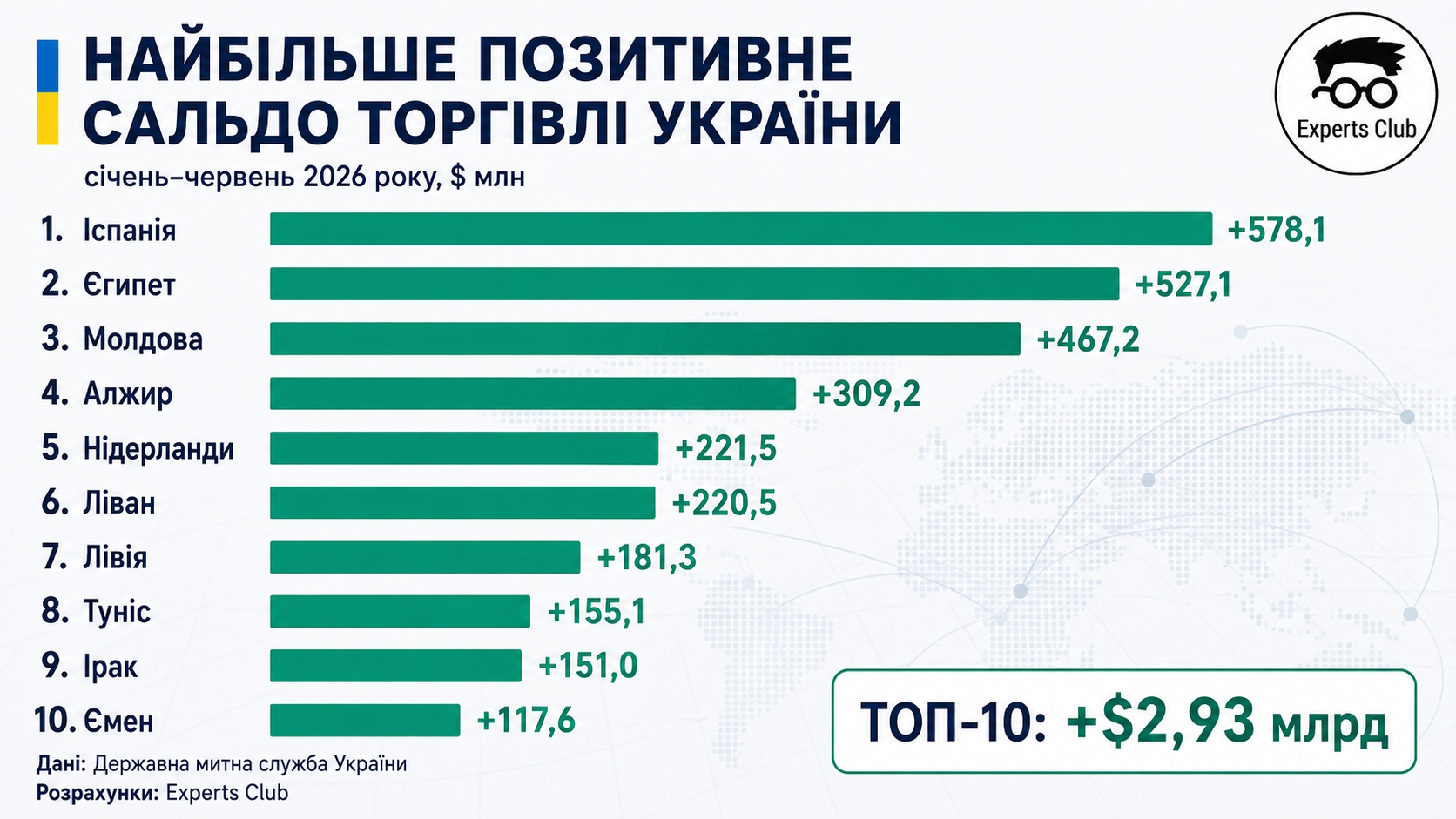
Ukraine had the largest positive balance in trade with Spain — $578.1 million. Exports to this country amounted to $1.09 billion, while imports — $513.0 million. Trade turnover between the countries exceeded $1.60 billion. Grain crops, primarily corn and wheat, as well as sunflower oil, other fats and oils of vegetable origin, oilseeds and certain food products formed the basis of Ukrainian supplies to the Spanish market. The high capacity of the Spanish agricultural and livestock sectors supports stable demand for Ukrainian grain and feed raw materials.
Egypt took second place with a surplus of $527.1 million. Ukraine exported $719.5 million worth of goods there, and imported $192.4 million. Exports exceeded imports by 3.7 times. Egypt remains one of the key sales markets for Ukrainian wheat and other grains. Vegetable oils, oil crops, food products and certain types of metal products also played a significant role in deliveries. The importance of this direction goes beyond bilateral trade, as Egypt is one of the largest food importers in the Middle East and North Africa region.
Moldova came in third place, with a positive trade balance of $467.2 million. Ukrainian exports reached $551.6 million, and imports - only $84.3 million. Exports exceeded imports by more than 6.5 times. Unlike most North African partners, the structure of supplies to Moldova was more diversified. It included electricity and other goods of the mineral group, food, metallurgical products, construction materials, chemical goods, machines and electrical equipment. Geographical proximity, road and rail logistics, as well as close production and consumer ties between the two countries play a significant role.
Spain, Egypt and Moldova together accounted for about $1.57 billion, or 40.7% of the total positive balance of Ukraine. The five largest surplus markets already provided 54.4%, and the top ten - 75.8%. This indicates a fairly high concentration of positive results in a limited number of areas.
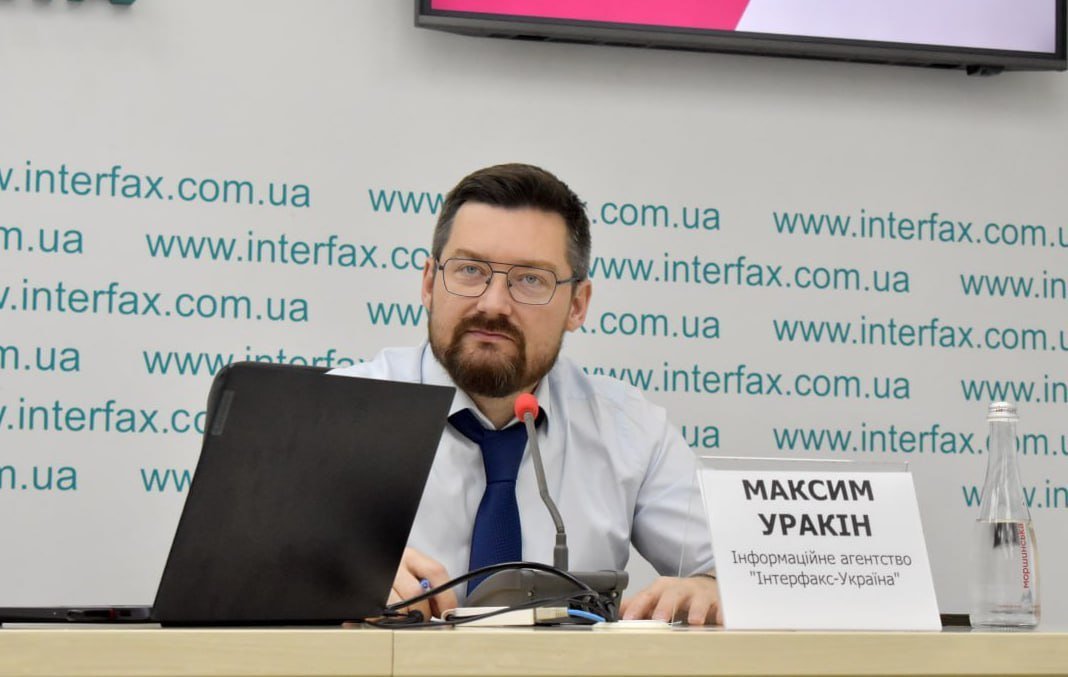
"The presence of a positive balance with 93 countries demonstrates that Ukraine maintains a wide export geography and the ability to generate foreign exchange earnings even under conditions of war, damage to production facilities and constant logistical risks. At the same time, almost 76% of the total surplus is accounted for by only ten markets, and a significant part of this result is formed by grain crops, vegetable oils and other agricultural products," emphasized Maksym Urakin, the founder of the Experts Club information and analytical center.
He believes that . such specialization gives Ukraine a competitive advantage, but at the same time makes exports dependent on the harvest, world prices, port capacity, insurance costs and stability of sea routes. Therefore, the quality of the positive balance is no less important than its nominal size.
The strategic task, according to Urakin, should be to increase the share of processed products — ready-made food products, fodder, biological products, metal products, equipment and technological solutions. This will make it possible to get more revenue from the same raw material base, create jobs inside the country and reduce dependence on price fluctuations on world commodity markets
Algeria took the fourth place in the ranking with a positive balance of $309.2 million. Exports to this country amounted to $388.6 million, imports - $79.3 million. Deliveries exceeded purchases by almost five times. The Algerian direction, like the Egyptian one, is largely based on the export of Ukrainian wheat and other grain crops. Among the important groups were also vegetable oils, products of processing of agricultural raw materials and certain types of ferrous metals.
The Netherlands took fifth place with a surplus of $221.5 million. At the same time, trade with them was the largest among all countries with a positive balance - $1.82 billion. Ukraine exported goods worth $1.02 billion, and imported $797.1 million. Compared with the markets of the North Africa's trade flows were much more balanced: exports exceeded imports by only 28%. Key Ukrainian supplies included grain, vegetable oils, meat and edible offal, oilseeds, food industry residues, and fodder. The Netherlands also functions as one of Europe's main logistics and trade hubs, so part of the imported products can be supplied to other EU markets in the future.
Lebanon took the sixth place with a positive balance of $220.5 million. Out of the export volume of $224.0 million, imports from this country amounted to only $3.5 million. Thus, Ukrainian supplies exceeded the counter flow of goods almost 65 times. The basis of exports was formed by grain crops, vegetable oils, oil raw materials, ready-made food products and certain types of metal products. Such an asymmetric structure of trade is characteristic of markets that are critically dependent on food imports, but have limited opportunities to supply their own products to Ukraine.
The positive balance with Libya amounted to $181.3 million: exports reached $200.5 million, imports - $19.2 million. In trade with Tunisia, the surplus equaled $155.1 million for exports $187.5 million and imports $32.4 million. Both directions have a similar product structure, dominated by grain crops, vegetable oils, other food products, as well as certain groups of metal products. Together, Egypt, Algeria, Libya and Tunisia provided Ukraine with a positive balance of more than $1.17 billion, which emphasizes the strategic importance of North Africa for Ukrainian exports.
Ninth place was taken by Iraq with a surplus of $151.0 million. Ukrainian exports amounted to $151.1 million, while imports were practically non-existent - only about $72 thousand. Tenth place was taken by Yemen, to which Ukraine supplied goods for $117.6 million, without recording significant counter-imports. Grain crops, vegetable oils and other food products were of key importance for both countries. Trade with them actually had a one-way export character, which ensured a high surplus, but at the same time increased dependence on the solvency of buyers, the political situation and the safety of sea transportation.
The total surplus of the top ten was $2.93 billion. At the same time, exports to these countries reached $4.65 billion, imports - $1.72 billion, and turnover - $6.37 billion.
Next places followed by Kazakhstan with a positive balance of $98.9 million, Jordan - $94.9 million, the United Arab Emirates - $92.7 million, Bulgaria - $88.2 million and Uzbekistan - $82.7 million. After including these five countries, the combined surplus of the 15 leading destinations reached $3.39 billion, or 87.7% of the positive result for all surplus markets.
The structure of exports to this group was more diverse. Ukraine supplied Kazakhstan and Uzbekistan with food, pharmaceutical products, ferrous metal products, machines and equipment. Grains, vegetable oils and foodstuffs played a significant role in trade with Jordan. Agricultural goods, food products, metals and certain industrial products were exported to the United Arab Emirates. The Bulgarian direction combined deliveries of grain, oil crops, fats and oils with trade in metal products, machines and electrical equipment.
Georgia, Cyprus, Syria, Djibouti, Armenia and Portugal also belonged to the countries with a noticeable positive balance. On the other hand, in trade with Latvia, exports and imports were almost balanced: for a trade turnover of $251.3 million, the positive balance was only about $0.6 million.
The geography of surplus markets shows that Ukrainian exports rely on several different economic zones at the same time. Spain, the Netherlands and Bulgaria provide access to the European Union market; Egypt, Algeria, Libya and Tunisia form the North African food direction; Moldova is an important neighboring market; Iraq, Yemen, Jordan and the Persian Gulf states represent the Middle Eastern vector; Kazakhstan, Uzbekistan, Georgia and Armenia support the presence of Ukrainian manufacturers in Central Asia and the Caucasus. Long-term contracts, affordable military and commercial risk insurance, export credit, systematic trade diplomacy, harmonized veterinary and phytosanitary procedures, and investment in ports, rail, border infrastructure, and overseas logistics centers are needed. The positive balance should be transformed not just into a statistical difference between exports and imports, but into a steady flow of foreign exchange earnings, taxes, investments and jobs in Ukraine," Maksym Urakin notes.
The analysis of the commodity structure shows that the main source of the positive balance remained the agro-food complex. Grains, vegetable oils, oil crops, meat, fodder and ready-made food products formed the basis of supplies to most of the surplus partners. According to the State Customs Service, the total Ukrainian export of food products in the first half of 2026 amounted to about $12.5 billion, metals and their products - $2.2 billion, machines, equipment and vehicles - $1.8 billion.
Thus, the positive balance with individual countries remains an important stabilizer of Ukraine's foreign trade, but so far it cannot compensate for the general commodity deficit. Further strengthening of positions on the markets of Spain, Egypt, Moldova, Algeria and the Netherlands should be accompanied by diversification of the nomenclature, development of the processing industry and an increase in the share of non-raw materials exports. It is the transition from a predominantly raw material model to the supply of products with a higher added value that can make the positive balance more sustainable and useful for the country's long-term economic recovery.
Calculations cover trade in goods for January-June 2026 and do not include foreign trade in services.