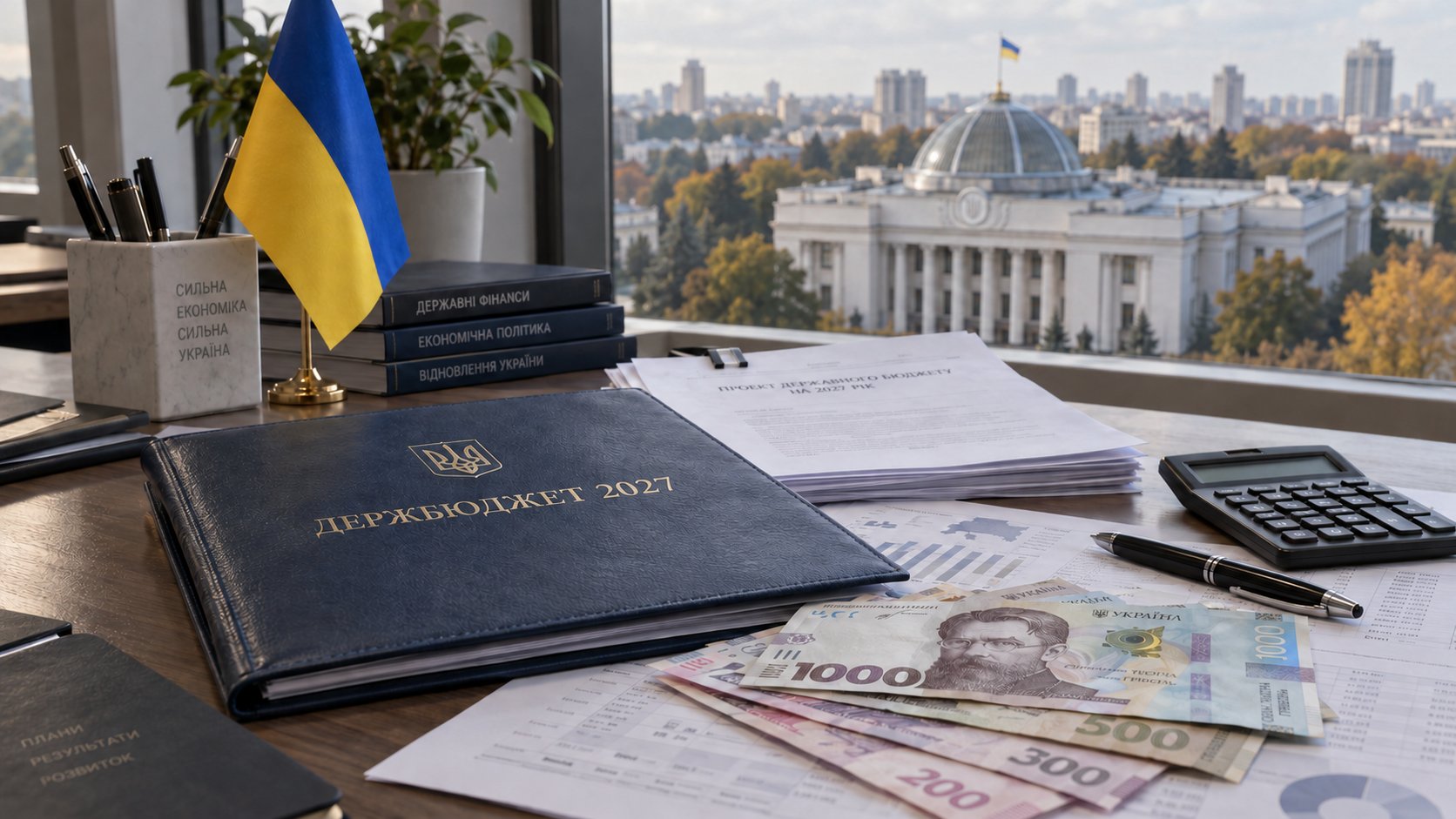
The draft state budget for 2027 foresees 7.272 trillion UAH of expenditures for domestic revenues of 3.155 trillion UAH. This proportion determines its main feature: the Ukrainian economy provides less than half of the planned expenses, and the fulfillment of the rest depends on international revenues and debt financing. At the same time, the government foresees an increase in certain taxes, a further weakening of the hryvnia and an almost unchanged nominal resource for armaments in its comparative presentation.
The macroeconomic forecast with a real GDP growth of 1.3% looks restrained. It is much more difficult to confirm the financial security of all expenses: part of the income requires laws that have not yet been passed, the blocking of maritime logistics worsens export prospects, and the announced $52.6 billion in international support needs to be coordinated with the indicators of both budget funds.
The analysis concerns the initial government version of draft law #16000, registered on September 15, 2026. These are proposals of the Cabinet of Ministers, which may change during consideration by the Verkhovna Rada. For comparison, the plan for 2026 with changes was used, given in the materials for the project, and not the budget originally approved last year.
The projected deficit is 1.666 trillion UAH
Budget revenues in the amount of 5.648 trillion UAH already include 2.493 trillion revenues, designated as grants by the Ministry of Finance. Internal revenues amount to UAH 3.155 trillion. Therefore, it would be a mistake to assess the ability of the Ukrainian economy to finance the budget based on the total revenue figure. colspan="1" rowspan="1">
Indicator, UAH billion
2026, plan with changes | 2027, project | Change | Total Income | 5,195.9 | 5,648.0 | +452.1 |
Internal revenue | 2,889.1 | 3,155.0 | +265.9 |
Grants according to the classification of the Ministry of Finance presentation | 2 306.8 | 2 493.0 | +186.2 |
Expenditures | 6,407.1 | 7,272.0 | +864.9 |
Deficit with budget lending | 1 250.7 | 1 666.1 | +415.4 |
Indicators and the basis of comparison are given in the presentation of the Ministry of Finance, slides 4, 6 and 29. Amounts are rounded.
The difference between expenses and income is approximately 1.624 trillion hryvnias. However, the official deficit is larger: net budget lending is added to it. The project provides for the provision of loans for UAH 57.259 billion and repayment for UAH 15.094 billion. Accordingly, the deficit amounts to UAH 1,666.129 billion, or about 15% of the projected GDP. It is this amount that should be used in the financing analysis.
Domestic revenues cover approximately 43.4% of expenditures. The difference between them is UAH 4.117 trillion, even before taking into account net lending. This shows the scale of dependence on an external resource more accurately than the deficit indicator itself: a large part of external support is already included in revenues and therefore reduces the official deficit.
The economic base of the budget remains weak
The explanatory note shows a contraction of real GDP by 0.6% in the first quarter of 2026 and growth of only 0.4% in the second. In January–July, industrial production decreased by 0.3%, construction by 11.2%. Production in the field of electricity, gas and steam supply decreased by 12.9%, in metallurgy - by 8.9%.
At the same time, processing industry as a whole increased by 1.4%, machine building - by 34.9%, production of finished metal products - by 24.2%. This is an uneven economic dynamic: individual industries are expanding, while energy constraints and the weakness of traditional industries hold back the overall output. The growth of a separate defense-related industry cannot be transferred to the entire tax base.
Macroeconomic indicator | Year 2026, expectations | Year 2027, forecast |
Nominal GDP, billion UAH | 10,105.3 | 11,144.4 |
Real GDP growth | 1.6% | 1.3% |
Average consumer inflation | 8.0% | 8.6% |
Inflation December to December | 9.2% | 8.0% |
Average monthly salary, UAH | 30,088 | 34,409 |
Average exchange rate, hryvnia per dollar | 44.4 | 47.1 |
Year-end exchange rate, hryvnia per dollar | 45.8 | 48.3 |
Export of goods and services, billion dollars | 55,802 | 57,864 |
Imports of goods and services, billion dollars | 124,989 | 137,520 |
Sources: explanatory note, macro forecast. The expected result of 2026 differs from the forecast based on which the budget was adopted for this year.
The government assumes nominal GDP growth of 10.3%, while internal budget revenues should increase by 9.2%. By itself, this ratio does not look excessive. Taxes are paid from the nominal value of sales, salaries, profits and imports, so even with weak real growth, inflation increases the hryvnia tax base.
However, such an increase in income does not mean a corresponding improvement in the financial condition of enterprises and the population. More expensive energy, logistics and imports can simultaneously increase turnover in the hryvnia and reduce profitability. The average salary of UAH 34,409 is also a macro forecast, not a guaranteed income for each employee.
The weakness of the forecast lies in the fulfillment of all its prerequisites at the same time. To obtain the planned taxes, production work, available energy, employment, imports, solvent demand and timely external support are needed. The modest GDP forecast does not eliminate the risk of losses due to further disruptions or prolonged export restrictions.
Port blockades pose risks to revenues and the currency market
According to the UCAB, in August 2026 the export of the main groups of agro-food products decreased to 2.15 million tons from 3.67 million tons in July, i.e. by 41.5%. These are physical volumes for one month; they cannot be automatically interpreted as the same drop in annual foreign exchange earnings.
In the August position on export support, the Ukrainian Chamber of Commerce and Industry reported on the actual blocking of the sea route at the end of July. The association estimates the need to redirect around 30 million tons of cargo, additional logistics costs of more than €1.1 billion and a risk to export revenue of around €7 billion in the 2026/27 marketing season. This is an industry estimate of possible losses under appropriate conditions, and not the already recorded reduction in revenues in calendar year 2027. Logistics costs and revenue at risk should also not be calculated mechanically.
According to the State Customs Service, in January-August, Ukraine exported goods worth $26.6 billion and imported $66.3 billion. According to customs statistics, the commodity deficit amounted to $39.7 billion. Food provided $15.4 billion of exports, or approximately 58%. Therefore, the violation of agrarian logistics affects the main source of commodity export revenue.
The budget forecast for 2027 foresees an increase in exports of goods and services by 3.7%, and imports by 10.0%. The negative balance should worsen from $69.2 billion to $79.7 billion. These figures cover goods and services and are calculated using a different methodology, so they cannot be directly compared to eight months' worth of customs data. However, both series show a large-scale need for external financing.
The expected growth of exports against the background of problems with ports requires an explanation: what volumes will be provided by alternative routes, how world prices will change, whether sea transportation will be resumed and when. Without these prerequisites, the assessment of export revenue remains a significant risk of the macro forecast. At the same time, the short period of decline does not yet provide sufficient grounds to determine the exact size of the export shortfall for the entire next year.
For the budget, the loss of one dollar of export revenue is not equal to the loss of one dollar of income. Exports of goods are mostly zero-rated for VAT, and businesses can receive input VAT refunds. Budgetary losses occur due to a decrease in profits, salaries, employment, internal purchases and payments of related enterprises. The currency effect is more direct: lower revenue means a lower supply of foreign currency.
Taxes on consumption and imports form the basis of domestic revenues
The project provides for UAH 859.3 billion of VAT on imported goods and UAH 384.9 billion of domestic VAT, including reimbursement. Together, this is UAH 1.244 trillion, or about 39.4% of domestic revenues. Therefore, a drop in exports does not necessarily cause a simultaneous drop in all budget revenues: an increase in imports and prices can support VAT even when the foreign trade balance worsens.
Such a mechanism has a limit. Import needs currency, and consumption needs population income. Without the help of partners, investments or other foreign exchange earnings, a prolonged increase in imports against weak exports puts pressure on reserves and the exchange rate. In addition, a part of imports has tax benefits, so the growth of all imports is not transferred to customs payments in proportion to one another.
The Ministry of Finance plans to increase the revenues of the general fund administered by customs from 876 billion to 1.038 trillion UAH, or by 18.5%. The combination of the forecast increase in dollar imports by 10.0% and the increase in the average annual exchange rate of the dollar by 6.1% gives about a 16.7% increase in its hryvnia value. Therefore, a significant part of the increase in customs revenues is explained by the nominal base. But the final result will depend on the product structure, benefits, rates and administration. This is a calculation illustration, not a separate forecast of fees.
The redistribution of payments between funds should be taken into account separately. In particular, UAH 217 billion of the military levy is planned to be transferred to a special fund. A decrease in the corresponding indicator of the general fund due to such a transfer does not mean a loss of money by the budget and in itself is not an increase in the tax rate.
The increase in taxes is already taken into account in the calculations, but requires legislative preparation
The explanatory note to the budget directly lists the additional revenues that should appear in case of amendments to the Tax Code.
Proposed change | Additional revenues in 2027, billion UAH |
Increase in VAT rate | 58,700 |
Continuation of 50% tax on bank profits for the I-III quarters | 38,500 |
VAT on goods in international parcels and express shipments | 11,800 |
Additional increase excise taxes on fuel | 8,306 |
Together according to these four decisions | 117,306 16–17. In the presentation of the Ministry of Finance, the VAT increase is described as an increase in the rate by one percentage point, that is, the base rate from 20% to 21%.The amount of UAH 117.3 billion is approximately 3.7% of domestic revenues. This is an essential resource, but it does not solve the problem of a trillion-dollar dependence on international support. Before the adoption of the relevant laws, it should be assessed as a legally determined revenue. The government is linking an additional UAH 58.7 billion from VAT with business insurance against war risks and other financial support for enterprises. Additional UAH 8.3 billion of excise tax — with insurance of fuel sector enterprises. Therefore, waiving these taxes will require a review of the relevant programs or a search for revenue replacement. It is not correct to interpret the entire specified amount as an automatic lack of funds for already existing general obligations. For the consumer, the transition from VAT 20% to 21% at the same price without tax means an increase in the final price by approximately 0.83%: a product for UAH 120 would cost UAH 121. This is the arithmetic effect for a standard rate transaction. It does not mean an automatic increase of the entire consumer price index by one percentage point: the actual impact depends on the benefits, the structure of consumption and how the business will distribute the additional tax between the price and its own margin. The government expects another UAH 64.9 billion from the reduction of customs evasion after the reform of the State Customs Service. According to the explanatory note, the corresponding resource should be directed to the special fund for security and defense, provided that the general plan of customs revenues is exceeded. This is the result to be obtained, not the already secured balance of money. Together with the four tax decisions, it is about UAH 182.2 billion, or 5.8% of internal revenues, which depend on legislative and administrative results. These proposals differ from the expected 14 billion UAH of personal income tax from income through digital platforms: the explanatory note refers to the already adopted law No. 4903-IX of June 9, 2026. Here, the main issue is the practical administration and implementation of the collection forecast. The excise duty on fuel is also increasing according to the previously established schedule. In the budget calculations, the rate for gasoline changes from €300.8 to €329.9 per thousand liters, for diesel - from €253.8 to €291.9, for liquefied gas - from €198 to €223. This is, respectively, approximately 9.7%, 15.0% and 12.6% increase in the exact excise rate. These percentages are not a forecast of the increase in the price of a liter of fuel: there are other components in its price, and the euro excise tax also depends on the exchange rate. The additional UAH 8.306 billion in the above table refers to a separate proposal beyond the considered schedule. A general increase in all import duties does not follow from these materials. The import duty plan is UAH 74.686 billion, the export duty is UAH 1.907 billion. The scale of these revenues is much smaller than import VAT. Taxation of VAT on international parcels is also not the same as an increase in the customs duty rate. So, the answer to the question about taxes is concrete: the government expects to increase the burden in several areas, but the final parameters will be determined by individual laws. The need for international support has increased by $1.8 billion In the presentation of the Ministry of Finance for 2027, $52.6 billion is indicated against $50.8 billion in the 2026 plan. The increase is about 3.5%. This is a direct answer to the question of a change in the officially declared need according to a comparative indicator. At the same time, $52.6 billion cannot be considered the sum of all external revenues to both budget funds without additional reconciliation. In revenues, 2.493 trillion UAH of grants are shown, and in terms of financing, another 1.823 trillion UAH of gross external borrowings are shown. The arithmetical amount is 4.316 trillion hryvnias, or approximately $91.6 billion at the average annual exchange rate of 47.1 hryvnias to the dollar. Such a recalculation is a check of budget aggregates, and not an assessment of a new uncovered request to partners: it does not establish the currency, schedule, form of receipts and possible features of the accounting of individual mechanisms. For the general fund, the explanatory note separately indicates 741.4 billion UAH of assistance under the code 42030000 and 1,731.2 billion UAH of external borrowings. Together, this is about $52.5 billion at the same exchange rate, that is, a value close to the announced $52.6 billion. This is a calculated argument in favor of different coverage of indicators, but not a complete official reconciliation. An unequivocal conclusion requires a breakdown of each program by fund, budget classification, and currency. Therefore, it is incorrect to declare the difference between $91.6 billion and $52.6 billion a new unsecured "hole." It is also incorrect to claim that $52.6 billion fully describes the external dependence of the budget. The public presentation of the project should be supplemented by an agreed table of financing: what is already established by international decisions, what conditions need to be fulfilled, what amounts remain subject to negotiations and what are targeted defense resources. Classification as a grant also does not always convey the legal construction of an international instrument. Ukraine Support Loan, Ukraine Facility and ERA funds are listed in the presentation along with grant receipts. Some of these mechanisms use a loan or conditional return structure. To analyze the debt and future payments, the terms of a specific agreement are needed, not just the name of the revenue section. The largest identified European program is the €90 billion Ukraine Support Loan for 2026-2027. The Council of the EU provided approximately €30 billion for macro-financial and budgetary support and €60 billion for defense needs. By 2026, the decision opened access to €45 billion: €8.35 billion in macro-financial assistance, €8.35 billion through the Ukraine Facility, and €28.3 billion for defense industrial capabilities. Therefore, €90 billion is not an annual resource of 2027, and the defense part cannot be arbitrarily redirected to any civilian expenditures. The $8.1 billion IMF program is designed for 48 months. This entire amount cannot be included in the funding of one year 2027 either. In the first review, completed in July, the IMF confirmed the availability of financial assurances from partners within its program while emphasizing the importance of timely support. This indicates the presence of an international financial base, but is not an automatic confirmation of every September budget figure or the unconditional payment of all future tranches. Estimating the additional need due to future revenue shortfalls can only be conditional. Every 1% of non-fulfilment of domestic revenues is approximately UAH 31.6 billion, or $0.67 billion at the budget exchange rate. A 5% loss would mean about UAH 157.8 billion, or $3.35 billion. This is the sensitivity of the calculation, not a forecast of losses. It should not be added to the risk of individual taxes, if they are already included in the assumption of non-performance. The deficit is planned to be covered mainly by net external borrowing The total volume of new loans in 2027 is UAH 2.367 trillion. However, a part of these funds is needed to repay the previously raised debt. Source or payment, billion UAH | Year 2027 | New external borrowings | +1,822.9 | Repayment of external of debt | −162.3 | New domestic borrowings | +544.4 | Repayment of domestic debt | −544.4 | rowspan="1">+3.5 Net funding | 1,666.1 |
Source: presentation of the Ministry of Finance. Domestic loans and their repayment are the same in the plan. Therefore, the planned placement of bonds of the domestic government loan mainly ensures the refinancing of existing obligations, and the net contribution of the domestic market to financing the deficit is zero. Instead, the net external resource is approximately UAH 1.661 trillion. Privatization of UAH 2 billion is of secondary importance against the background of such a deficit. Gross external borrowings are growing against the 2026 plan by UAH 344.1 billion. The increase in all state borrowings amounts to UAH 469 billion; these two indicators should not be confused. The increase in the net need for financing to UAH 1.666 trillion is combined with the need to repay UAH 706.7 billion of the principal amount of the debt. For aid delays, the government can change the payment schedule, attract more domestic loans, use available balances or revise expenditures. However, each possibility is limited. Additional T-bills require demand from banks and other investors and increase future interest payments. Leftovers are a disposable resource. The reduction of civilian programs in a defense-dominated budget has a limited scope and can weaken the economy and social stability. There is no direct emission financing of the NBU in the above deficit coverage plan. Therefore, the conclusion about the inevitable large-scale "printing of money" does not follow from the project itself. But a long gap between actual revenues and protected liabilities will force the government to change the budget or its financing sources. Maintenance of the state debt will cost UAH 474.1 billion, of which UAH 266.4 billion will be domestic debt and UAH 207.7 billion will be external. This is approximately 15% of internal budget revenues. Interest expense is included in expenses, while principal repayment is reflected in financing; adding both amounts to the deficit would result in double counting. The marginal state debt at the end of 2027 is set at 12.307 trillion UAH, or approximately 110.4% of GDP. With a guaranteed debt of UAH 382.2 billion, the total amount reaches about 113.9% of GDP. Such a ratio is not an independent proof of an imminent debt crisis: terms, concessions, deferrals and conditions of return are important. However, it leaves little room for replacing large international support with ordinary market loans. The budget scenario already foresees a weakening of the hryvnia The average annual exchange rate is set at 47.1 hryvnias per dollar against the expected 44.4 in 2026. This is an increase in the hryvnia price of the dollar by approximately 6.1%. At the end of the year, the forecast is UAH 48.3 against UAH 45.8, or 5.5% more. So, the answer to the question of devaluation within the framework of the government scenario is positive. But the budget exchange rate is a calculated assumption, and not an obligation of the NBU to set a certain quote. The pressure on the foreign exchange market is already noticeable. According to the NBU data provided in the explanatory note, the net sale of currency for January-August 2026 amounted to about $33 billion, $9.3 billion more than in the corresponding period of the previous year. Reserves fell from about $57.3 billion at the end of 2025 to $48.7 billion at the end of August. These data show the strong demand for foreign exchange and the role of external inflows in maintaining reserves. Long-term export restrictions will increase these pressures. Timely help from partners, on the contrary, enables the NBU to smooth out fluctuations. The exact rate cannot be determined from the budget deficit: it is also affected by private capital flows, import needs, currency restrictions, expectations and decisions of the regulator. For the budget, a weaker hryvnia increases the hryvnia equivalent of foreign aid and part of import taxes. At the same time, the prices of imported weapons, energy sources, medicines and foreign currency debt payments are increasing. Therefore, devaluation does not create a free resource to cover the deficit. It redistributes costs between the budget, business and the population and can accelerate inflation. Defense and security receive about two-thirds of the budget The declared resource is UAH 4.885 trillion, or 43.8% of GDP. However, it has UAH 30 billion of state guarantees. The guarantee creates a conditional obligation of the state, and is not identical to an immediate budget payment. Without it, the direct resource of programs and reserves is approximately UAH 4.855 trillion, or 66.8% of all expenditures. 25px;"> |
Direction according to the presentation of the Ministry of Finance, UAH billion | year 2026 rowspan="1">1,454.2 | 1,791.7 | +337,5 |
Armament and military equipment | 2 297.1 | 2 298.5 | +1.4 |
Other expenses | 372.2 | 499.9 | +127.7 |
Funds reserve | 213.6 | 264.9 | +51.3 |
State guarantees | 30.0 | 30.0 | 0 |
Source: presentation of the Ministry of Finance; rounding of individual rows may affect the amount.
The total defense resource increases by approximately UAH 517.8 billion, or 11.9%. Of this increase, 337.5 billion hryvnias, about 65%, are for cash support and salaries with accruals. The corresponding amount increases by 23.2%. According to the aggregated indicator, it is not possible to determine which part of the change is related to the number, the size of payments or the structure of the personnel.
According to the comparative table of the Ministry of Finance, expenditures on armaments increase by only about 0.06%. With rising prices and a weaker hryvnia, an unchanged nominal amount means the risk of a decrease in purchasing power. The exact size of the change cannot be deduced from consumer inflation: defense contracts have a different structure of prices, currencies and terms, and the localization of production can change the result.
At the same time, official materials need coordination. The explanatory note indicates UAH 2,393.4 billion for the creation, purchase, modernization and repair of weapons and special equipment, while the presentation - UAH 2,298.5 billion. The difference is about UAH 94.9 billion. Without clarifying the composition of these indicators, it is impossible to combine them into one series or compare the broader indicator of 2027 with the narrower one of 2026. The given conclusion about an almost constant resource concerns precisely the comparative series in the presentation.
In the program section, approximately 3.763 trillion UAH are provided for the Ministry of Defense, of which 2.099 trillion UAH are in a special fund. This is more than half of the resource of the department. The general indicator of security and defense also covers other bodies of the sector and the reserve, so it is not identical to the budget of the Ministry of Defense or the amount of funds for the purchase of weapons.
The size of the special fund means a high dependence on the receipt of its specific targeted sources. Merely recording expenses in the law does not guarantee that each source will arrive in the right month. For defense, the financing schedule is of particular importance due to production cycles and the need to advance contracts.
Separately, the government expects at least UAH 1 trillion in military logistical assistance from partners in addition to the budget resource. This is a notice of additional need and expectation of support; it should not be submitted as already received weapons. During the subsequent accounting of aid, it is necessary to avoid re-inclusion of the same supplies in different amounts.
According to open aggregated data, it is possible to assess the structure of defense financing, but it is not possible to reliably establish its sufficiency for all military needs. This requires data on the intensity of hostilities, numbers, stocks, nomenclature and prices of supplies. The reasoned conclusion is narrower: the increase in the total amount is largely supported by personnel, while procurement remains dependent on prices, a special fund and the help of partners.
Civil expenditures are nominally increasing, but not all compensate inflation equally
After subtracting approximately UAH 4.855 trillion of direct security and defense resources from all expenditures, about UAH 2.417 trillion remains. Public debt service absorbs about a fifth of this balance. The rest should provide social programs, education, medicine, public administration, rehabilitation and other functions.
Direction, UAH billion | 2026 | 2027 | Increase |
Social sphere according to the government presentation | 467.7 | 540.3 | 15.5% |
Education | 277.7 | 328.5 | 18.3% |
Health care | 257.5 | 292.5 | 13.6% |
Support for IDPs by aggregate programs | 71.6 | 83.2 | 16.2% |
Veteran politics | 17.5 | 20.5 | 17.1% |
Source: presentation of the Ministry of Finance on expenditures.
Note that these are the government's priority directions, not mutually exclusive sections of the functional classification. In particular, support for IDPs overlaps with social and housing programs. It is impossible to add up all the lines to determine the total expenses.
If the growth is conditionally adjusted for the average annual inflation of 8.6%, the real increase in financial resources will be about 6.4% in the social sphere, 8.9% in education and 4.6% in medicine. This is a general estimate of the purchasing power of the sums, and not an exact index of the cost of services. Medicines, energy and salaries may become more expensive at different rates; the number of recipients also changes.
Out of UAH 540.3 billion of social resources, UAH 292.8 billion is transferred to the Pension Fund for pension provision. It grows by approximately UAH 41.5 billion. The indexation of pensions from March is taken into account in the calculation. At the same time, the entire resource of the Pension Fund for pension payments is estimated at 1.279 trillion UAH and includes its own revenues. This full amount cannot be added to the state social expenditures, because the budgetary transfer is already a component of it.
Increasing the transfer does not mean the same percentage increase of each pension. The need depends on the number of beneficiaries, special pension obligations, indexation and income of the Social Insurance Institution. In particular, the project takes into account the increase in the number of former military personnel and their family members, whose pensions are financed with the participation of the state budget.
Approximately UAH 11.5 billion is provided for prosthetics and rehabilitation aids. About 51.9 billion hryvnias will be allocated to increase benefits for children with disabilities and persons with disabilities since childhood in the relevant direction. These are separate components of the social resource, and not additional amounts of more than UAH 540.3 billion. The effectiveness of such costs will depend on the availability of services, the targeting of assistance and the implementation of procurement programs.
The total support of IDPs for 83.2 billion UAH includes housing, compensation, social and other programs. Direct housing assistance amounts to UAH 39.6 billion, only UAH 0.9 billion more than in 2026. Its budget increases by approximately 2.3%, which is lower than the average annual inflation of 8.6%. With constant coverage, this would mean a decrease in the real resource; the actual result will depend on the number of recipients and access criteria. The overall increase in the support package for IDPs is not equal to the same increase in the monthly payment.
Educational expenses of UAH 328.5 billion increase by UAH 50.8 billion. UAH 235.3 billion is earmarked for teachers' wages, about UAH 8.3 billion for scholarships, and UAH 19.4 billion for school meals. Educational public investments amount to UAH 13.5 billion. Paying for work, access to full-time education, shelter and a network of institutions are important at the same time. An increase in state funding does not eliminate restrictions related to security and the ability of communities to maintain infrastructure.
Health care is allocated 292.5 billion UAH, which is 35 billion UAH more than the current plan. The medical guarantee program grows to UAH 225 billion, or by UAH 33.5 billion. Of this amount, 21.7 billion UAH are allocated to "Affordable medicines"; adding them to UAH 225 billion as a separate resource would be a double calculation. UAH 20.8 billion is planned for the centralized purchase of medicines, and UAH 10 billion for health screening for people over 40 years old.
For medicine, not only the general increase is important, but also the sufficiency of tariffs to cover the cost of treatment. More expensive imported drugs and equipment, the need for rehabilitation and staffing shortages may absorb some of the increase. The stated guideline of the average salary of a doctor is at least 30,000 UAH, depending on tariffs, contracting and the financial condition of institutions; this is not the same as a guaranteed payment to every doctor.
24.220 billion hryvnias are provided for scientific and scientific and technical activities, of which 19.691 billion hryvnias are for the general fund. This is about 0.22% of the projected GDP. In particular, UAH 13.010 billion refers to the research of the National Academy of Sciences of Ukraine and branch academies, and UAH 7.916 billion to priority research and development of higher education institutions. The indicator covers the budget resource of the specified area; it should not be equated with all the economy's spending on research, including private or defense development.
With this scale of funding, science policy needs clear priorities: maintenance of research teams, competitive selection, equipment and connection with production. The mere presence of innovative programs is not enough to draw a conclusion about a significant expansion of research capabilities. The amount for science is about twenty times less than servicing the national debt, which shows the severity of the general budget restrictions.
The business and economy support package of UAH 96 billion also needs deciphering. A significant part of it is UAH 45 billion for housing financing through YeOselya and Ukrfinzhitlo. Another UAH 29 billion is earmarked for the National Development Institution, UAH 10.1 billion for the Fund for the Development of Innovations, in particular, defense technologies. Therefore, UAH 96 billion is not a solid amount of non-refundable grants to enterprises and is not fully aimed at compensating export losses. UAH 7.4 billion is separately indicated in the presentation to support agricultural producers.
The support of regions and communities in the amount of UAH 133.6 billion does not cover all local self-government finances. The total forecast resource of local budgets exceeds UAH 1 trillion and includes own revenues and transfers. Public investments in the amount of UAH 111.8 billion, for their part, cover projects in several areas and state guarantees, so they also cannot be completely added to the already listed sectoral amounts.
These intersections explain why the infographic of priorities does not replace the budget classification. To assess real redistribution, it is necessary to compare the same programs, sources of funding and composition of recipients. A nominal increase in the broadly named direction may hide a weaker increase or a reduction of a separate important payment.
Funds for conducting election campaigns in the submitted edition are not included
365.1 million UAH is provided for the Central Election Commission against 275.2 million UAH in the 2026 plan. In the comparative program application, these funds are listed under the program of leadership and management in the field of elections and referenda. The financing of the work of the Central Election Commission is not an estimate for presidential, parliamentary or local elections.
The final regulations instruct the Cabinet of Ministers together with the Central Election Commission to submit proposals for changes to the budget to finance the preparation and holding of regular elections after the termination or cancellation of martial law. Therefore, the project provides for the procedure of further allocation of funds under appropriate conditions. This provision does not set the date of the elections and does not prove that they will be held in 2027.
The financial realism of the budget depends primarily on the fulfillment of specific conditions. Domestic revenue growth of 9.2% is in line with the nominal size of the economy in the forecast, but part of the increase relies on new taxes and the effectiveness of customs reform. Deterioration of export logistics simultaneously weakens enterprises and increases the economy's need for currency. The planned weakening of the hryvnia partially supports nominal incomes, but increases costs.
International financing remains decisive: it is present both in revenues and in the sources of covering the deficit. The official need for support increases by $1.8 billion, however, in order to assess the entire external resource, it is necessary to reconcile the indicators of the general and special funds and disclose the confirmed amounts by programs. Without such a reconciliation, it is impossible to reliably name the additional unsecured amount of aid.
The project can be implemented with the timely receipt of partner funding, the implementation of established tax decisions and the absence of a significant deterioration of production and logistics relative to the government scenario. Deviations from these conditions will require changes to the budget. The main risk is that the need for defense and social payments arises regardless of the timing of adoption of tax laws, the results of customs reform and the receipt of international tranches.