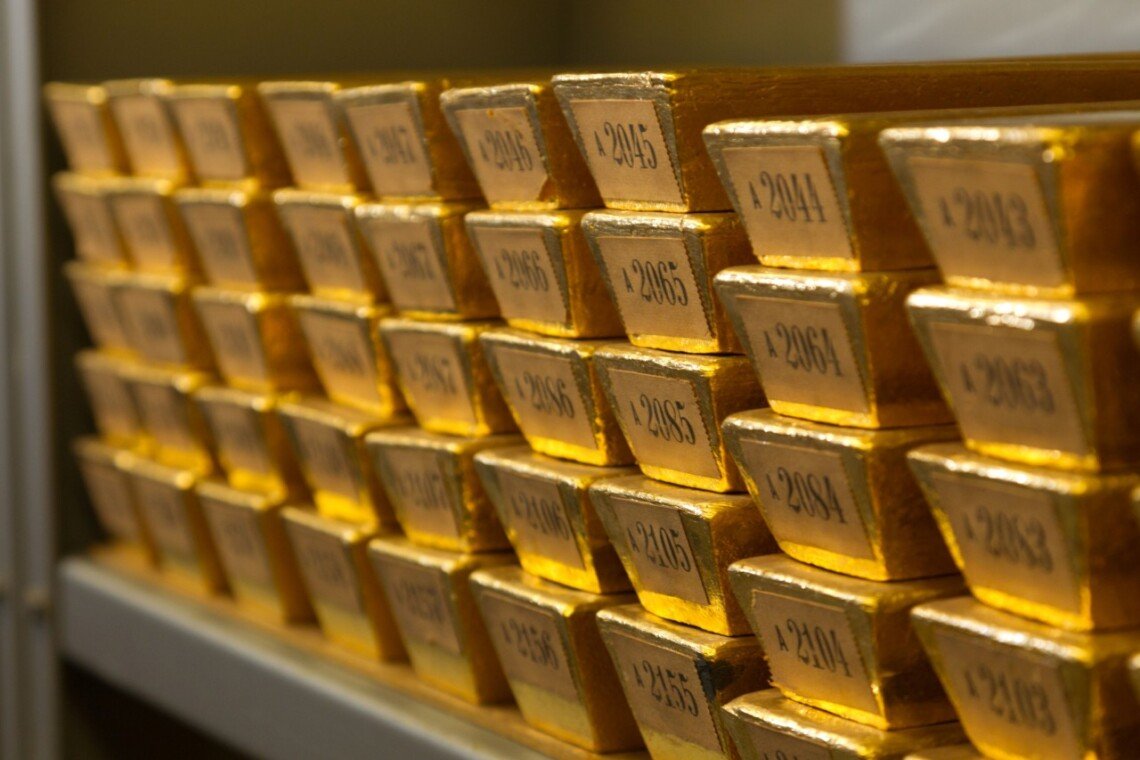
The United States remains the largest public holder of gold in the world, with official reserves of more than 8.13 thousand tons. Germany holds the second position with about 3.35 thousand tons, while China, after accelerating purchases in the summer of 2026, has moved closer to France and Italy. This is evidenced by the analysis of the Experts Club information and analytical center based on the publications of the World Gold Council, the International Monetary Fund and national reserve management bodies.
At the same time, the growth of the role of gold in international reserves has several components: the purchase of additional metal, an increase in its market price and changes in the value of other reserve assets. Therefore, an increase in the dollar or euro valuation of the gold reserve in itself does not yet indicate large-scale purchases by the central bank.
As reported by the World Gold Council WGC, the international Gold Reserves by Country database was updated on September 3, 2026. The basis is the International Financial Statistics of the IMF, supplemented by other official reports. At the same time, the quarterly panel contains data as of the end of June, the monthly reviews cover July transactions, and some national institutions have already released August results. publication of the rating must be distinguished from the date of the indicator itself. Older values are used for late reporting countries. Such a list characterizes the distribution of published reserves, but is not a completely synchronous account of world gold for one calendar day.
The ten largest state holders of gold according to the compared published indicators look like this. Volumes in the table are rounded to whole tons, and the reporting period is indicated separately.
Place | Country | Gold reserves, tons | Reporting period of data used |
|---|---|---|---|
1 | USA | 8,133 | June 2026 year |
2 | Germany | 3 350 | March 2026 |
4 | France | 2 437 | March 2026 |
5 | China | 2,387 | August 2026 |
6 | Russia | 2 277 | July 2026 |
7 | Switzerland | 1,040 | June 2026 |
8 | India | 881 | June 2026 |
9 | Japan | 846 | June 2026 year |
10 | Poland | 640 | July 2026 |
According to the calculations of the Experts Club based on the above indicators, these ten states together possess approximately 24.44 thousand tons of gold. The USA accounts for about a third of the supply of this top ten. American reserves are about 2.4 times larger than German reserves, and the combined reserves of the USA, Germany, Italy and France amount to about 16.37 thousand tons.
International organizations are not included in the ranking of states. According to the Gold in the IMF report published by the International Monetary Fund, the Fund owns approximately 90.5 million troy ounces, or 2,814.1 tons of gold. If it were included in the common list of all official holders, it would be located between Germany and Italy. That is why the positions of individual countries in different publications may differ even for the same physical volumes.
Significant European stocks were mostly formed long before the current procurement cycle. According to the Gold reserves section published by the Bank of Italy, Italy's reserves stabilized at around 2,452 tonnes in the late 1990s. Its current size reflects long-term accumulation, post-war currency inflows and the subsequent formation of the European monetary system.
The most notable change among the largest holders in the summer of 2026 was the acceleration of Chinese purchases. According to the data of the State Administration of Foreign Exchange Control of the People's Republic of China SAFE, released on September 7, 2026, at the end of August, China's gold reserves amounted to 76.73 million troy ounces, compared to 76.08 million at the end of July.
At the standard conversion of a troy ounce of 31.1034768 grams, the August volume corresponds to approximately 2,386.57 tons. The monthly increase was 650,000 ounces, or about 20.22 tons.
This was the largest monthly addition to China's gold reserves since October 2023, according to the WGC in its September 14, 2026 China Market Review. Official reserves increased for 22 months in a row.
At the end of December 2025, China declared 74.15 million ounces of gold. Therefore, according to Experts Club calculations based on annual and monthly SAFE statistics, for January-August 2026, the physical stock increased by approximately 80.25 tons, or by 3.5%. This gives a more accurate picture of the scale of the stockpile than a comparison of just the last two months.
After the August replenishment, China's gap with France narrowed to around 50 tonnes, and with Italy to 65 tonnes. At the same time, it is not enough to mechanically extend the pace of one month to determine the terms of a possible review of positions in the rating: the volumes of future purchases of the People's Bank of China are unknown in advance.
Chinese indicators also demonstrate the impact of revaluation. According to the Official reserve assets statistics for 2026, published by SAFE, the value of the gold reserve increased from $306.35 billion at the end of July to $350.08 billion at the end of August. The increase was about 14.3%, while the physical volume of the metal increased by only 0.85%.
According to the Experts Club calculations, the share of gold in China's total official reserve assets increased from about 8.08% to 9.08%. Therefore, the August increase in this share reflected both the purchases and the increase in the price of the already accumulated metal.
Poland remained the largest buyer among central banks that published the results of operations for January-July 2026. According to the Central Bank Gold Statistics review published by the WGC on September 3, 2026, the Polish regulator has bought around 90 tonnes since the start of the year, including around 8 tonnes in July. The cumulative reserve has reached about 640 tons, or about 28% of the country's international reserves.
The Polish regulator's publicly declared benchmark is 700 tons. Based on the July indicator, approximately 60 tons remained to be purchased to achieve it. The available stock corresponded to about 91% of the target physical volume. At the same time, the tonnage guideline and the target share of gold in the structure of reserves are different indicators: the second is also influenced by market prices and the volume of other assets.
The reported results of individual central banks for seven months of 2026 allow us to see the heterogeneity of global demand.
Country | Net change in gold reserves in January-July 2026, approximately tons |
|---|---|
Poland | +90 |
China | +60 |
Uzbekistan | +40 |
Kazakhstan | +29 |
Czech Republic | +12 |
Russia | −50 |
Turkey | −85 |
According to the September 3 WGC Monthly Review, in In July, central banks reported a total net purchase of about 23 tons of gold. For January-July, the corresponding indicator was approximately 130 tons, compared to approximately 160 tons for the same period of the previous year. According to the calculations of the Experts Club, this is about 19% less.
At the same time, the purchase volumes of the largest buyers may exceed the total net result: sales of other institutions are subtracted from the metal purchased by them during aggregation. That is why the sum of positive values in the list of buyers is not equal to the increase in stocks of the entire official sector.
Estimating global demand also requires a distinction between reported transactions and broader research estimates. As the WGC explains in the methodological notes to Gold Demand Trends, the quarterly estimates take into account not only published changes, but also estimated transactions that have not yet been disclosed by official institutions. Monthly statistics on reported purchases have a narrower scope.
According to the Q2 2026 Gold Demand Trends report published by the WGC on July 30, net demand from central banks and other official institutions was 288.9 tonnes in April-June. This is up 62% from 177.9 tonnes in Q2 2025.
Meanwhile, for the entire first half of 2026, the WGC estimates net demand at around 345 tonnes, the lowest first half result since 2022. So, the strong recovery of purchases in the II quarter was combined with a weaker result at the beginning of the year.
The scale of the revisions of statistics is also indicative. In the July publication of the WGC, the demand estimate for the first quarter of 2026 was lowered from the previously published 244 tons to about 57 tons. This underscores the need to note the date of the study's release and use updated estimates during year-on-year comparisons.
Long-term activity in the formal sector remains elevated. According to the Central Bank Gold Reserves Survey 2026, published by the WGC, over the previous four years central banks have been hoarding an average of around 1,000 tonnes of gold each year, compared to an average of around 500 tonnes in the previous decade.
However, the average hides significant fluctuations. In its annual review published on 29 January 2026, the WGC estimated net purchases for 2025 at 863.3 tonnes versus 1,092.4 tonnes for 2024, a decline of around 21%. Even this result was significantly higher than the average annual volume of 473 tons for 2010-2021, given in the same study.
The differences between countries also concern the role of gold within their reserve portfolios. According to the WGC in its review of September 3, 2026, in the July statistics, gold accounted for approximately 87% of Uzbekistan's reserves and 75% of Kazakhstan's reserves. For Poland, the indicator was equal to about 28%, for China - 8%, for the Czech Republic - 6%.
Thus, a reserve smaller in terms of tonnage can have a much greater weight for a specific state. To assess the concentration of the reserve portfolio, the absolute place in the world ranking should be considered together with the share of gold, the currency structure of other assets and the country's needs for international liquidity.
Serbia continued to gradually increase its stock. According to the Reserves and Foreign Exchange Market Report published by the National Bank of Serbia on September 11, 2026, gold reserves reached a record 54,991.8 kg, or approximately 54,992 tons, at the end of August. Their value was EUR 6.959 billion, and the share in gross international reserves was 22.6%.
During August, the Serbian regulator purchased 16 gold bars with a total weight of 200.7 kg from Serbia Zijin Copper on the domestic market. Since the beginning of the year, purchases amounted to about 2.5 tons. The total amount of gross international reserves of Serbia at the end of August reached EUR 30.805 billion and covered approximately seven months of imports of goods and services.
According to the National Bank of Serbia, the value of gold reserves increased by EUR 795.5 million in August alone, mainly under the influence of market factors. According to the calculations of the Experts Club, this corresponded to an increase of approximately 12.9%, while the physical stock increased by approximately 0.37%.
For Ukraine and the countries of Central and South-Eastern Europe, the comparison of individual published indicators looks like this. Large values are rounded, and the difference between reporting periods is indicated in the table.
Country | Gold reserves, approximately, tons | Reporting period | ||
|---|---|---|---|---|
Poland | 640 | July 2026 | ||
Hungary | 110 | June 2026 | ||
Romania | 104 | June 2026 2026 rowspan="1"> Serbia | 54.99 | August 2026 |
Bulgaria | 41.04 | June 2026 | ||
Slovakia | 31.69 | March 2026 | ||
Ukraine | 27.37 | June 2026 |
According to Trading Economics with reference to WGC, gold reserves of Ukraine in the II quarter of 2026 amounted to 27.37 tons, unchanged compared to the I quarter. In the statistical series of this source, which begins in 2000, the largest indicator was recorded in the I quarter of 2014 — 42.61 tons.
According to the calculations of the Experts Club, the current physical stock is approximately 35.8% less than that quarterly maximum. This comparison characterizes the amount of monetary gold and does not reflect the change in total international reserves of Ukraine, which also include currency assets, securities, special borrowing rights and a reserve position in the IMF.
Serbia's August gold reserve was approximately twice the Ukrainian figure for the II quarter. However, from this ratio, it is not possible to draw a conclusion about the general availability of reserves of the two states. Such an analysis requires comparative data on all international assets, future foreign payments, imports, and availability of financing.
In the wider global context, official institutions hold a significant, but far from overwhelming, portion of humanity's accumulated gold. According to the above-ground stock research, updated by the WGC on August 18, 2026, the total volume of metal mined throughout the history at the end of the II quarter was estimated at approximately 222.6 thousand tons.
Of this volume, about 39 thousand tons accounted for central banks. This is approximately 17.5% of the total supply, or 18% after rounding in the WGC publication. About 99,700 tons were concentrated in jewelry, 47,800 tons in bullion and coins, and about 4,000 tons in gold exchange funds.
The estimate of the accumulated global stock should be distinguished from the amount of national reporting in international tables. These statistical products have different approaches and coverage. Therefore, the share of the USA or the top ten countries in the "world reserves" can only be correctly indicated with a clear indication of the basis of calculation, its date and included holders.
The change in the market value of the metal significantly affects the global proportions as well. According to the report The international role of the euro, published by the European Central Bank on June 2, 2026, at the end of 2025, gold accounted for about 27% of total official reserves, which include foreign exchange assets and gold. By comparison, the share of US Treasuries was approximately 22%, and Euro reserves were 15%.
ECB emphasizes that to a large extent such ratios were explained by revaluation. According to the calculation using the price of gold at the end of 2023, its share would be about 16%, the share of the euro - also 16%, and US Treasuries - about 26%.
This significantly clarifies the interpretation of the headlines about the change in the world reserve system. A rise in gold does not necessarily mean a commensurate sale of dollar assets. In addition, US Treasury securities are only one type of dollar assets, so their share cannot be equated with the entire dollar component of international reserves.
A separate policy direction of central banks is changing the locations of metal storage. As reported by the Dutch central bank DNB in a press release dated September 2, 2026, approximately 86 tons of gold were moved from New York and Ottawa to London between March and August to increase liquidity and preparedness for crisis situations.
After the operation, London's share of Dutch gold placement increased to 32.1%, the Netherlands remained with 30.8%, and the USA and Canada — 18.5% each. DNB's total stock of about 612.4 tonnes was unchanged.
According to DNB, a significant part of the transaction was carried out through the sale of approximately 59 tonnes in New York and the purchase of a corresponding volume in London; the other part was provided by physical transportation. An example like this shows why the announcement of a sale or shipment of gold should be evaluated in light of the entire transaction and its ultimate impact on the stock.
Central bank expectations for gold remain largely positive. According to the Central Bank Gold Reserves Survey 2026, published by the WGC on June 16, 76 institutions participated in the survey, which was conducted between February 5 and May 19. The number of answers to individual questions varied, as some of them were voluntary.
Among respondents to the relevant questions, 89% expected an increase in global central bank gold reserves over the next 12 months, and a record 45% expected an increase in their own gold reserves. Another 74% predicted a moderate or significant decline in the dollar's share of global reserves over the next five years.
However, these responses reflect expectations, not actual transactions. The study also showed different ways of financing future purchases: half of the respondents to the corresponding question indicated domestic purchase programs for the national currency, and 38% - the sale of existing reserve assets. Therefore, the accumulation of gold can occur through various mechanisms and does not always require a reduction in the currency portfolio.
According to the Experts Club, international statistics show a combination of the historical concentration of large reserves in the USA and Western Europe with the active accumulation of metal by a number of countries in Central Europe and Asia. China is gradually approaching the leading European holders, Poland is building up physical reserves, and the Czech Republic and Serbia are consistently expanding their reserves.
At the same time, the pace of this process remains uneven. Assessing real changes in reserve policy requires simultaneous monitoring of tonnage, net purchases, market revaluation, structure of other assets, and storage conditions. This is how you can separate the long-term accumulation of gold from short-term price fluctuations and technical operations with reserves.