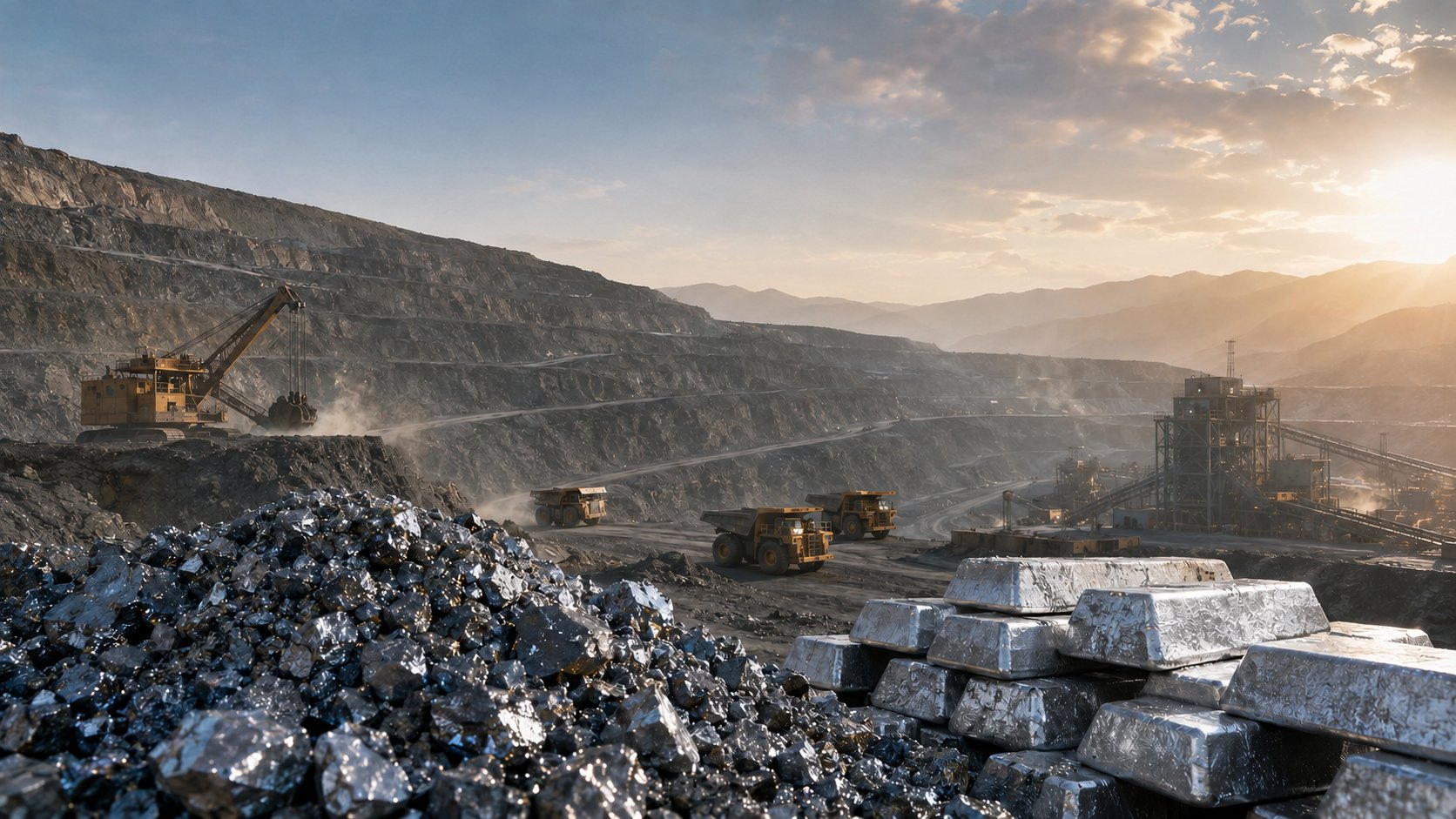
China retained its status as the world's largest producer of zinc in 2025, while Peru and Russia showed the most notable growth among the leading mining countries. Global zinc production has returned to growth after several years of weak dynamics.
This is evidenced by the Mineral Commodity Summaries 2026 of the US Geological Survey (USGS), published on February 6, 2026 and subsequently updated in May. The USGS calls this report the earliest comprehensive source of data on global mineral production for 2025.
Top Zinc Producing Countries in 2025
According to the USGS, the top producers are ranked as follows:
Place | Country | Production in 2025 | Production in 2024 |
|---|---|---|---|
1 | China | 4.10 million tons | 4.00 million tons |
2 | Peru | 1.50 million tons | 1.27 million tons |
3 | Australia | 1.10 million tons | 1.10 million tons |
4 | India | 870 thousand tons | 870 thousand tons |
5 | Mexico | 780 thousand tons | 773 thousand tons |
6 | USA | 670 thousand tons | 759 thousand tons |
7 | Bolivia | 500 thousand tons | 512 thousand tons |
8 | Russia | 430 thousand tons | 310 thousand tons |
9 | Kazakhstan | 360 thousand tons | 380 thousand tons |
10 | Sweden | 230 thousand tons | 239 thousand tons |
Thus, the ten largest producers provided about 10.54 million tons, or 81% of world production, based on USGS estimate of 13 million tons.
China increased production by about 2.5% to 4.1 million tons, accounting for nearly a third of global production. The gap between China and its nearest competitors remains huge, with Chinese companies producing almost as much zinc as Peru, Australia and India combined.
One of the main changes in 2025 was an increase in production in Peru by about 18%, to 1.5 million tons. The country strengthened its second place in the world ranking. The International Lead and Zinc Study Group (ILZSG) attributed the growth, in particular, to increased production at the large Antamina polymetallic mine and the restoration of other capacities.
Russia's position has changed significantly. According to the USGS, production increased from 310,000 tons in 2024 to 430,000 tons in 2025, putting the country above Kazakhstan and closer to Bolivia. One of the key factors was the increase in production at the new Ozerny field in Buryatia, the production of concentrate from which began in September 2024. ILZSG also attributed the launch of Ozerny to the growth factors of European zinc production in 2025.
At the same time, the sanctions against the Russian zinc sector are targeted rather than industry-wide. The USA put on the blocking list OZGRK JSC and UMMC, which was also sanctioned by Great Britain, related to the Lake deposit. Ukraine initially introduced restrictions against UMMC and Ozerny Mining and Processing Plant LLC, and in 2025 against Vladyslav Sviblov, a businessman associated with the Ozerny project. At the same time, the current operator of the deposit, Ozerne LLC, is not listed separately in the Ukrainian sanctions register.
American zinc production decreased by approximately 12% — from 759,000 to 670,000 tons. The USGS attributed the decline mainly to a decline in zinc ore at the Red Dog mine in Alaska. The field operator Teck Resources reported that Red Dog directly reduced zinc production from 555.6 thousand tons in 2024 to 462.7 thousand tons in 2025.
Why there are no individual places from 11th to 20th in the ranking for 2025
Unlike some previous statistical selections, in Mineral Commodity Summaries 2026 USGS does not disclose individual indicators of countries after the tenth place. Their production is combined in the line Other countries — "other countries", which accounted for about 2 million tons of zinc in 2025. Therefore, forming an exact top-20 solely on the basis of open USGS statistics would be incorrect. A detailed ILZSG database by country exists, but the full array is available by subscription.
At the same time, there have been noticeable changes among second-tier manufacturers. Production in the Democratic Republic of the Congo grew especially quickly after the launch of the Kipushi mine. Ivanhoe Mines said this mine alone produced 203,200 tonnes of zinc concentrate in 2025, up from about 50,000 tonnes in the 2024 launch period. Thus, the DR Congo has already approached the group of countries immediately following the top ten in terms of volume.
ILZSG also noted production growth in 2025 in South Africa, Ireland, Bosnia and Herzegovina and other European countries. Irish production rebounded after the Tara mine came back online, with additional supply coming from new and expanding projects in DR Congo, Russia and Iran.
Global zinc production returns to growth
USGS estimates global zinc production in 2025 at about 13 million tons, against a revised 11.9 million tons a year earlier. At the same time, later ILZSG statistics give a slightly more conservative assessment of the market. According to the group, published on April 23, 2026, global zinc production in 2025 increased by 4.8%, i.e. to approximately 12.5 million tons. The difference is explained by the timing of the estimates, differences in methodology and subsequent data revisions.
The main sources of additional supply were the growth of production in Peru and China, the start-up and completion of project indicators of new large mines, including Kipushi in the DR Congo and Ozerny in Russia, as well as the recovery of a number of European enterprises.
At the same time, global zinc reserves that are economically available for mining are estimated by the USGS at about 240 million tons. The largest reserves are concentrated in Australia — about 64 million tons, China — 60 million tons, and Russia — 29 million tons. This is followed by Peru with 18 million tons and Mexico with 14 million tons.
Zinc remains one of the key industrial non-ferrous metals. The main direction of its use is galvanization of steel for corrosion protection, primarily in construction, infrastructure and the automotive industry. Zinc is also used in the production of brass, alloys, chemical products and a number of new energy storage systems.
Original source: U.S. Geological Survey, Mineral Commodity Summaries 2026, published February 6, 2026. Mineral Commodity Summaries 2026 - USGS
Additional source: International Lead and Zinc Study Group, global zinc market data and forecasts. International Lead and Zinc Study Group