Ukraine joined the group of Europe's fastest-growing defense technology markets, together with Finland and Estonia, and in terms of the amount of attracted foreign direct investment in the Space & Defense sector for the period from January 2021 to November 2025, it took third place among the European countries under consideration, according to the study Colliers Defense Deployment: How Europe’s military build-up and transformation reshapes property demand, analyzed by the Experts Club analytical center.
The Colliers report is dated May 6, 2026, and the company published a separate press release with its main conclusions on May 12. The study is devoted to the change of the European defense industry under the influence of rising defense costs, the development of unmanned systems, artificial intelligence, electronic warfare, cyber defense and autonomous technologies.
Colliers does not make a classic ranking of countries from the first to the twelfth place. Instead, analysts divided the leading European defense-tech markets into three levels.
Rating of countries by the level of defense tech development according to the Colliers classification:
Tier 1 — European leaders:
Big Britain
Germany
France
Turkey
Tier 2 - high-tech specialized markets:
Sweden
Italy
Spain
Norway
Poland
Tier 3 - fast-growing disruptors:
10-12. Finland, Estonia and Ukraine
Within each level, Colliers does not assign individual places to countries, so the positions 10-12 for the third group are a conditional reflection of the three-level classification, and not the official ranking of Ukraine relative to Finland or Estonia.
The authors of the study characterize Great Britain and France as complex developed military powers, Germany as an engineering base European industry, and Turkey as a producer of large-scale, rapidly growing technologies that have already been tested in combat conditions.
The second group specializes in certain high-tech areas - sensors, aerospace technologies, naval systems, missile technology and international defense programs.
Ukraine, Finland and Estonia are singled out by Colliers precisely for the rapid growth of new technological competencies. At the same time, Ukraine is mentioned separately in the report: the country is named one of the leading European defense-tech markets in the field of technologies that develop directly under the influence of combat experience, primarily drones, artificial intelligence, electronic warfare and autonomous systems.
An even stronger position of Ukraine is visible in a separate Colliers rating for foreign direct investment.
Based on data from fDi Markets, the company analyzed investments in the field of Space & Defense in the countries of Emerging and Western Europe for January 2021 - November 2025.
By the size of the columns of the published Colliers rating, the top ten looks like this as follows:
1. Great Britain
2. Romania
3. Ukraine
4. France
5. Latvia
6. Germany
7. Lithuania
8. North Macedonia
9. Poland
10. Bulgaria
It was followed by Italy, Luxembourg, Belgium, Spain, Finland, Turkey, Portugal, Hungary, Sweden, the Netherlands, Ireland, Norway, the Czech Republic, Denmark, Slovakia and a number of other countries.
Thus, Ukraine in the Colliers study is the third largest recipient of FDI in Space & Defense among the European markets considered, second only to Great Britain and Romania and ahead of France and Germany.
At the same time, Colliers does not indicate the exact monetary values of investments next to the countries in the graph, so Experts Club considers it correct to use the position in the rating, without translating the height of the graph columns into approximate amounts.
High position of Eastern European countries reflects a deeper change in the structure of the European defense sector. Investments are gradually shifting away from the traditional production of large platforms—tanks, planes, and ships—to areas related to data, software, sensors, artificial intelligence, and autonomy. This is exactly how Colliers explains the high positions of Ukraine, Romania, Latvia and Lithuania.
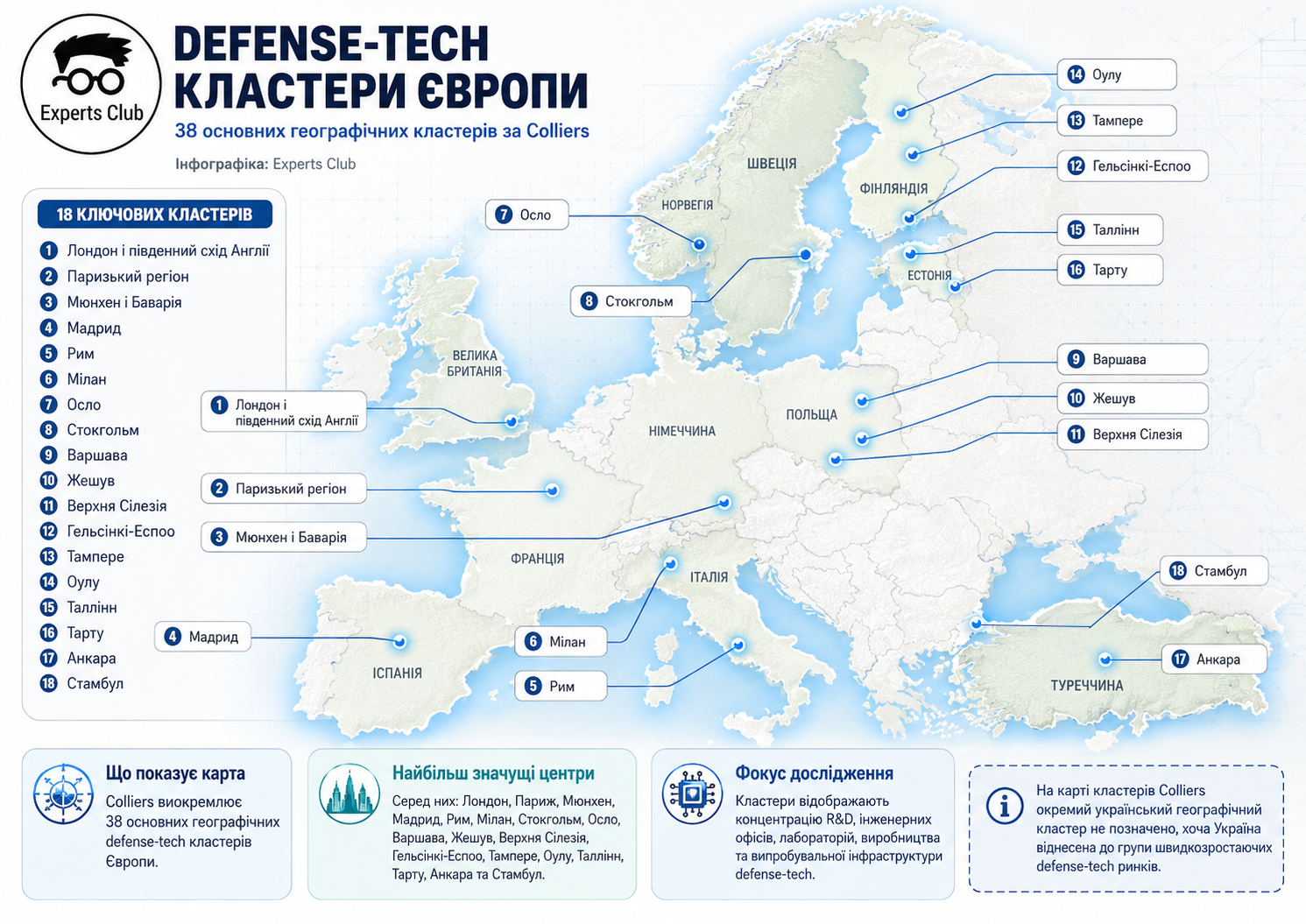
Colliers separately identified 38 main geographic defense-tech clusters in Europe. London and the southeast of England, Munich and Bavaria, the Paris region, Ankara, Istanbul, Madrid, Rome, Milan, Stockholm, Oslo, Warsaw, Rzeszów, Upper Silesia, Helsinki-Espoo, Tampere, Oulu, Tallinn and Tartu are among the most significant.
Here there is an important difference from the country ranking. On the map of 38 Colliers clusters, centers in the Czech Republic, Denmark, Estonia, Finland, France, Germany, Italy, the Netherlands, Norway, Poland, Spain, Sweden, Turkey and Great Britain are marked. A separate Ukrainian geographical cluster is not plotted on this map, although Ukraine itself is included in the third group of the most dynamic defense-tech countries and is separately highlighted as one of the leaders of battlefield-driven technologies. The authors of the study do not explain the reason for this difference.
According to the Experts Club assessment, it is the combination of two indicators that makes Ukraine's position particularly noticeable: the country does not yet have such a well-formed peaceful cluster infrastructure as Great Britain, Germany or France, but it is already included in the European group of fast-growing technology markets and at the same time ranks third in attracting industry FDI during the Colliers period under review.
Additional confirmation of the development of the ecosystem is the data of the Ukrainian defense cluster Brave1. Until July 2026, Brave1 provided developers with almost 1,000 grants with a total value of over UAH 5.8 billion. The Ministry of Defense calls Brave1 the largest venture investor in defense tech in Europe.
In 2025, at the Defense Tech Valley in Lviv, investors from Europe and the United States announced their intention to invest in Ukrainian defense technologies over $100 million, and in 2026 Ukraine launched the international platform Brave International, the total initial budget of joint programs with foreign partners exceeded EUR100 million.
Artificial intelligence remains one of the fastest growing areas. According to the Ministry of Defense of Ukraine, as of April 2026, more than 200 companies were involved in the development and production of unmanned systems using AI, more than 300 relevant developments are registered on the Brave1 platform, and more than 70 systems based on artificial intelligence and computer vision have already been used at the front.
For the real estate market, the growth of defense tech also creates a separate economic segment. Colliers notes the shift from traditional remote military plants to secure hybrid sites that combine R&D, engineering offices, laboratories and light manufacturing in one facility. Separately, the demand for sites for the production and testing of drones, protected laboratories and office-lab spaces with increased requirements for power supply, physical security and logistics is growing.
On a European scale, this process is supported by the ReArm Europe / Readiness 2030 program, the potential volume of mobilized defense costs in which Colliers estimates up to EUR800 billion. Investments by European venture capital funds in defense-tech startups, according to the data provided in the study, increased by more than 500% in 2021-2024 compared to the previous three years, and the volume of VC investments in European defense and defense-related technologies by the end of 2025 was estimated at approximately EUR 2.3 billion.
of Europe.
Primary source: Colliers, Defence Deployment: How Europe’s military build-up and transformation reshapes property demand,
Colliers Defense Deployment Full Report