A sharp institutional conflict has erupted in Poland between the government of Donald Tusk, President Karol Nawrocki, and judicial circles linked to the opposition. Police were sent to the Constitutional Tribunal building in Warsaw after its head, Bogdan Świączkowski, was removed. Amidst protests, the president cut short his trip to Senegal and is returning to the country.
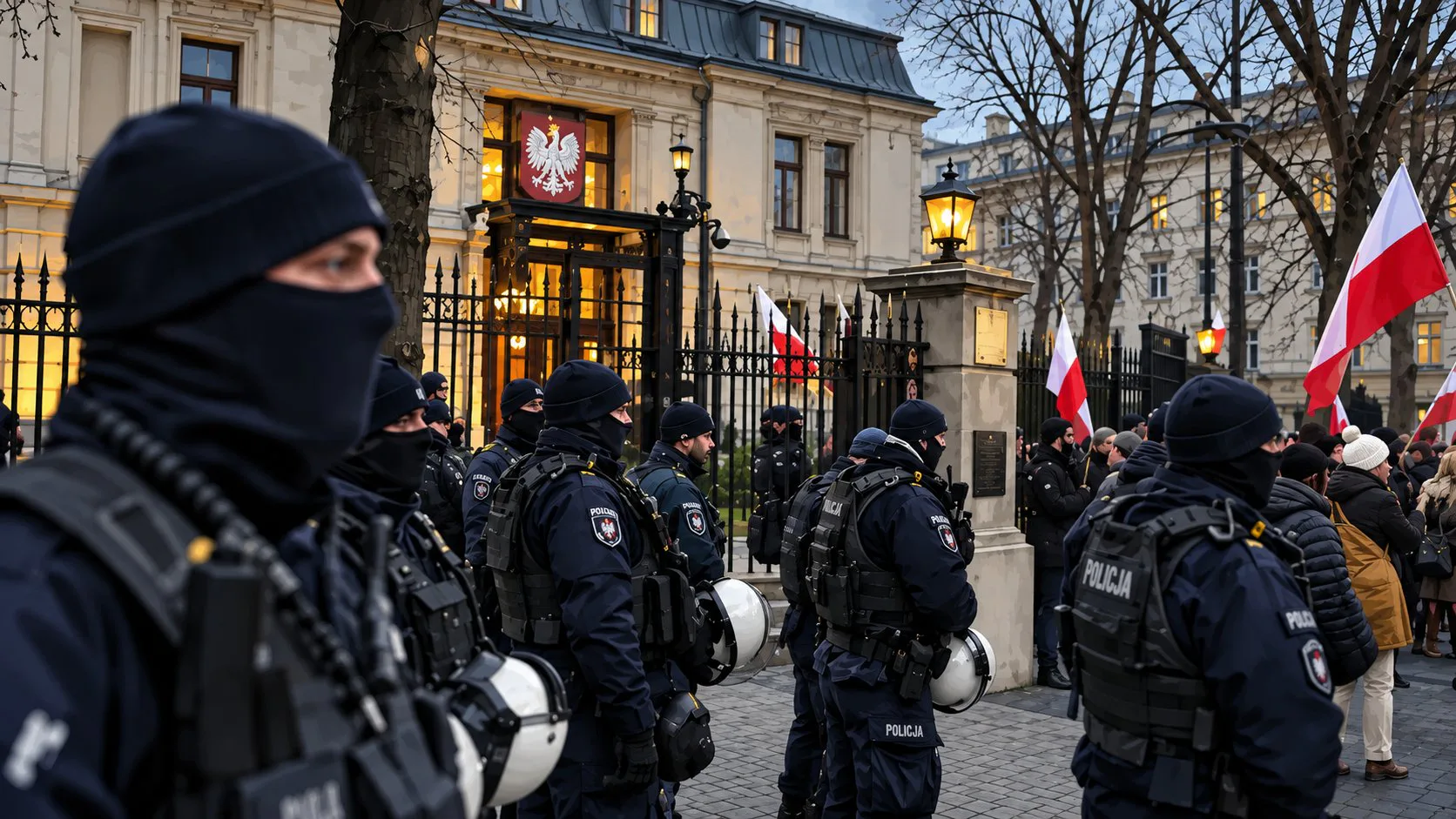
According to Polish and international media reports, 30 October, police took control of the Constitutional Tribunal's territory after the conflict over its leadership escalated. Some protesters tried to breach the fence, and police officers were pelted with various objects. According to Associated Press, law enforcement detained three individuals.
The escalation was triggered by Judge Anna Korwin-Piotrowska's announcement of the removal of the tribunal's head, Bogdan Świączkowski, and his deputy, Bartosz Sochański. Korwin-Piotrowska accused the court's leadership of obstructing the work of judges elected by the parliamentary majority and violations during the organization of judicial activities.
However, the legality of the removal decision itself became a subject of separate dispute. Tribunal representatives stated that Świączkowski remains its head and called what is happening an illegal seizure of the institution. The court's social media publications included accusations of an attempted coup d'état.
Prime Minister Donald Tusk, on the other hand, stated that restoring the rule of law is the government's duty and requires decisive action. Minister of Justice and Prosecutor General Władysław Żurek announced the filing of motions to lift the immunity of Świączkowski and his deputy.
President Karol Nawrocki, who was on an official visit to Senegal, ordered the plane to turn around and return to Poland. He stated that in the current situation, the head of state should be in the country.
The current standoff is a continuation of the long-standing crisis surrounding the Polish judicial system. During the rule of the Law and Justice (PiS) party in 2015–2023, reforms were implemented that changed the composition and functioning of judicial bodies. European institutions criticized these changes, pointing to threats to the independence of the judiciary.
After coming to power in 2023, the coalition led by Tusk set a course for restoring the independence of the judicial system and reviewing the controversial decisions of the previous government. However, this process encountered resistance from the conservative opposition and presidents politically close to PiS.
In 2025, Karol Nawrocki became president, supported by national-conservative forces. His confrontation with the government complicated the implementation of judicial reforms, as the head of state has the right of veto and participates in the legal procedures for appointing judges.
In 2026, the parliamentary majority activated the filling of vacancies in the Constitutional Tribunal. Nawrocki refused to accept the oath of some of the judges elected by parliament, and Świątecki, associated with the former PiS government, did not allow several new judges to perform their duties. As a result, a dispute arose not only regarding the personal composition of the court but also regarding which side has the right to determine its legitimate leadership.
Bek: which political forces are opposing each other
1. The government of Donald Tusk and the pro-European coalition.
The ruling coalition, which unites centrist and left-centrist forces, seeks to review the judicial legacy of PiS and restore relations with EU institutions on issues of the rule of law. From its point of view, the former reforms led to the politicization of the courts, and the refusal to admit new judges blocks the work of the Constitutional Tribunal.
For Tusk, the current conflict is both a legal and a political task. Success in judicial reform is necessary for the government to confirm its ability to fulfill pre-election promises.
At the same time, the use of force and administrative instruments within the framework of a controversial legal procedure creates risks for the ruling coalition itself: opponents can present its actions as an attempt to subordinate the judicial system to the current majority.
2. President Karol Nawrocki and the national-conservative opposition PiS.
Nawrocki is politically close to the Law and Justice party, which, after its defeat in the parliamentary elections 2023, seeks to regain influence over state institutions. The party is led by Jarosław Kaczyński, one of the key organizers of the conservative political camp.
This side insists on adhering to constitutional procedures and challenges the legality of the government's actions regarding the tribunal. The opposition views the removal of Święczołkowski and the police intervention as an attempt to seize the judicial institution.
Meanwhile, critics of PiS believe that the party seeks to maintain its influence over the courts, formed during its time in power. Therefore, the dispute over judicial independence is accompanied by a struggle for the political legacy of the previous government.
3. Judges and representatives of the legal community.
The judicial system does not act as a single political bloc. Some judges support the admission of new tribunal members and consider it necessary to restore its full operation. Others challenge the legality of personnel decisions and fear that the government is creating a precedent for executive interference in court activities.
The question of the legal basis for the removal of the tribunal's president is particularly acute. The specialist publication Notes from Poland cites the opinion of constitutional law expert Marcin Matczak, who questioned the possibility of applying the mentioned legal norm to the leadership of the Constitutional Tribunal. This indicates that the dispute cannot be reduced exclusively to the confrontation of two parties: it also concerns the boundaries of the powers of state bodies.
4. The European Union as an external institutional factor.
The EU is interested in upholding the principle of the rule of law and the independence of the judicial system of member states. European institutions have previously criticized the judicial reforms of PiS, and the current government has promised to eliminate the causes of the conflict with Brussels.
However, European support for restoring judicial independence does not mean automatic approval of any methods Warsaw attempts to use to carry out the reform. If controversial decisions are made without a convincing legal procedure, this may weaken the government's arguments even among its European partners.
What does this mean for Poland
The events surrounding the Constitutional Tribunal demonstrate how deeply the political conflict has penetrated the system of state governance in Poland. The question of the court's composition has turned into a dispute over who has the right to determine the constitutional legitimacy of state decisions.
In the near future, three main scenarios are possible.
The first is achieving a political-legal compromise that will allow the status of new judges and the leadership of the tribunal to be agreed upon. This will require the parties to abandon unilateral decisions and rely on procedures whose legitimacy will not be challenged by half of the political system.
The second is prolonged institutional confrontation, during which different groups of judges and politicians will challenge each other's powers. This option may further limit the work of the Constitutional Tribunal and complicate the implementation of reforms.
The third is further escalation with new protests, court hearings, and increased political mobilization. In this case, the conflict over the court will become one of the main factors in preparing for the next parliamentary elections.
The key risk for Poland lies in the loss of trust in the constitutional arbitration mechanism itself. If court decisions are perceived as a result of political control, and procedures for changing its composition as illegal capture, the institution intended to resolve disputes between branches of government itself becomes their main source.
Therefore, the further development of events will depend not only on which political force gains the upper hand in Warsaw, but also on whether the parties can establish a legally justified and widely accepted procedure for forming the Constitutional Tribunal.