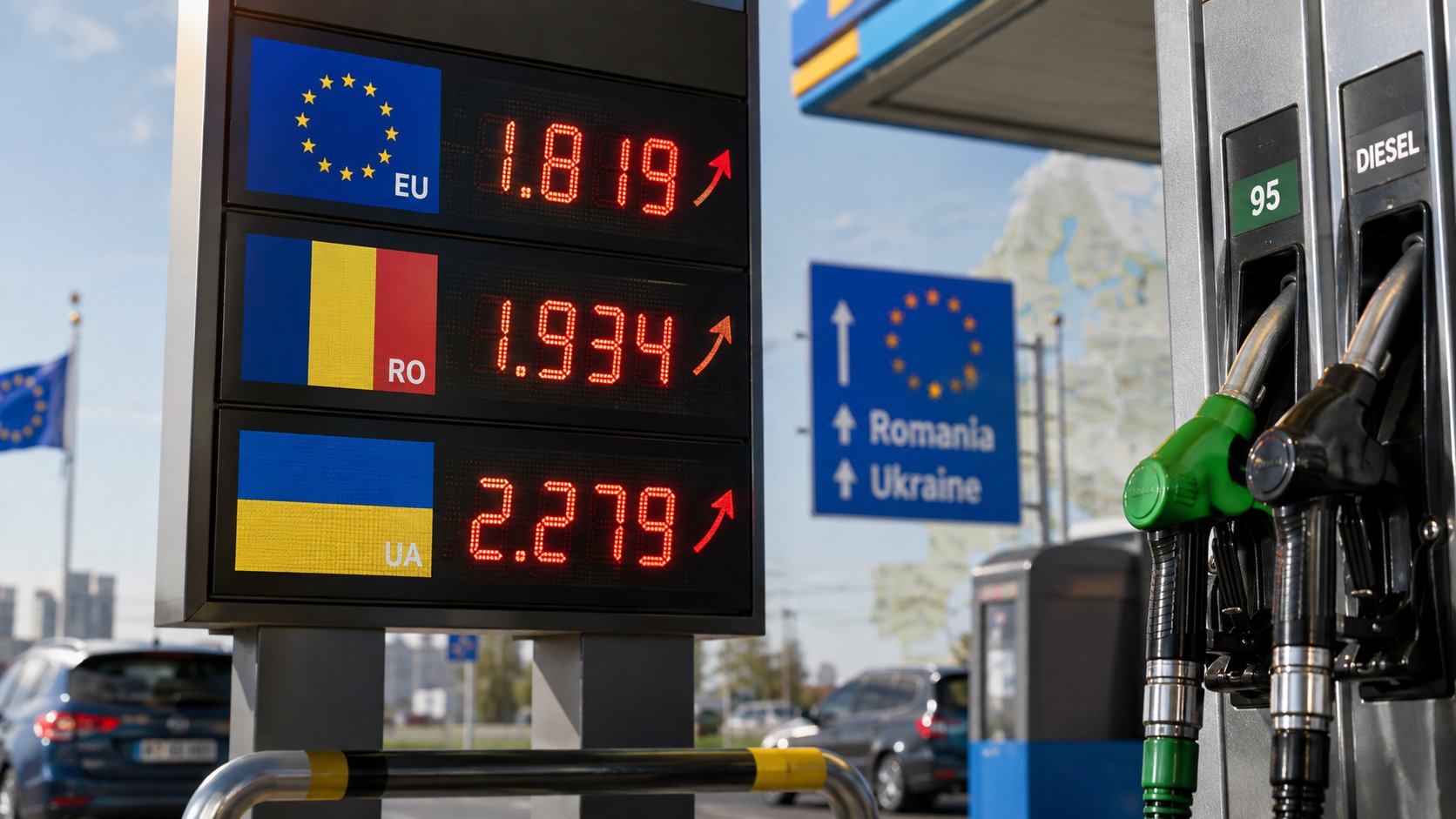
The biggest increase in the price of automobile fuel in the EU is in Romania, but it is even stronger in Ukraine
Editorial team•
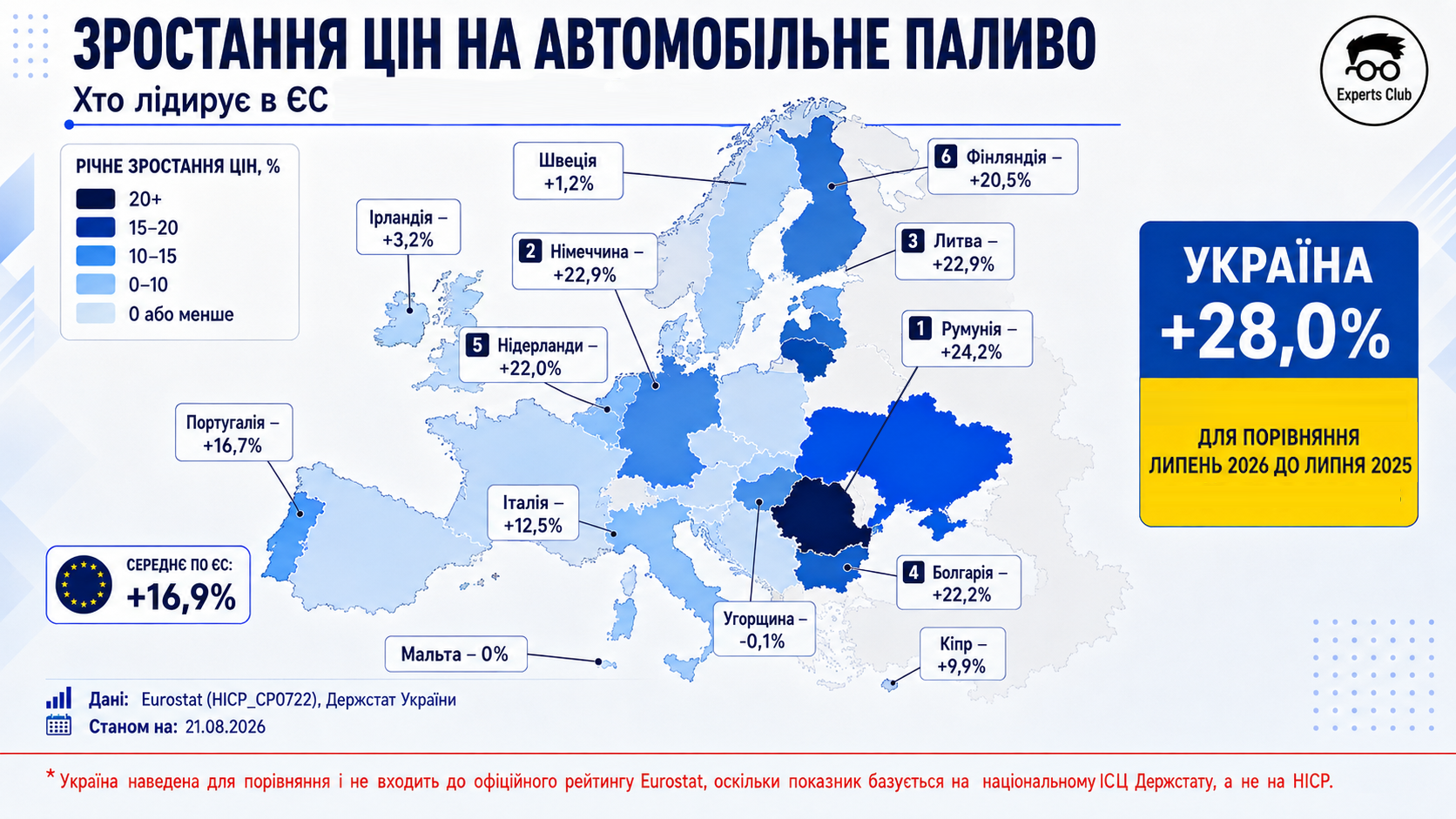
Car fuel and lubricants in the European Union in July 2026 rose in price by an average of 16.9% compared to July 2025, and the largest increase among the 27 EU countries was recorded in Romania — 24.2%, according to Eurostat data analyzed by the Experts Club information and analytical center.
Eurostat published the data on August 21, 2026. The statistics refer to the HICP harmonized index of consumer prices and category CP0722 - "fuel and lubricants for personal transport equipment". It includes, in particular, gasoline and diesel fuel.
The pace of price growth has changed noticeably in recent months. In May, fuel in the EU was 20.7% more expensive than a year earlier, in June the annual growth slowed to 13.7%, and in July it accelerated again to 16.9%. Year-on-year price increases were recorded in 25 of the 27 EU countries.
The first place is occupied by Romania, where prices have increased by 24.2%.
Next come Germany and Lithuania - 22.9% each, Bulgaria - 22.2%, the Netherlands — 22%, Finland — 20.5%. Thus, in all six countries, growth was significantly higher than the EU average of 16.9%.
The full order of countries on the Eurostat graph from the highest growth to the lowest looks like this:
Place
Country
Price growth July 2026 to July 2025
1
Romania
+24.2%
2
Germany
+22.9%
2
Lithuania
+22.9%
4
Bulgaria
+22.2%
5
Netherlands
+22.0%
6
Finland
+20.5%
7
France
above average EU
8
Belgium
colspan="1" rowspan="1">
10
Austria
close to EU average
11
Czech Republic
close to EU average
12
Portugal
+16.7%
13
Luxembourg
below the EU average
14
Poland
below the EU average
15
Slovakia
below EU average
16
Greece
below EU average
17
Italy
+12.5%
18
Spain
down +12.5%
19
Slovenia
down +12.5%
20
Croatia
down +12.5%
21
Cyprus
+9.9%
22
Latvia
less +9.9%
23
Estonia
less +9.9%
24
Ireland
+3.2%
25
Sweden
+1.2%
26
Malta
0%
Portugal took 12th place with an increase of 16.7%, Italy showed an increase of 12.5%, Cyprus - 9.9%. For the rest of the intermediate positions in the table, the Experts Club maintains the order of the official Eurostat schedule without artificially recalculating the visually displayed columns to the exact tenths of a percent.
Hungary stands out separately - it is the only EU country where the cost of fuel and lubricants has slightly decreased over the year, by 0.1%.
In Malta, prices have not changed. Eurostat separately explains this by the fact that retail fuel prices in the country have remained fixed since 2020.
In July, growth accelerated compared to the previous month. On average across the EU, diesel prices rose by 4.3% compared to June, gasoline by 4.7%. A month earlier, the dynamics were reversed: diesel in June became cheaper by 6.4%, gasoline by 4.2%.
The sharpest monthly increase in the cost of diesel fuel occurred in Poland - by 13.4%, Germany - by 12.7% and Greece - by 12.1%. Poland was also in the lead for gasoline, with an immediate increase of 17.2% for the month, followed by Germany with 11% and Spain with 7.1%.
At the same time, a decrease was observed in a number of countries. Diesel became cheaper in Cyprus by 7.9%, in Sweden by 7.4%, and in Ireland by 6.4%. Gasoline became cheaper in Sweden by 11.1%, in Cyprus by 5.4%, and in Ireland by 4.1%.
For comparison, in Ukraine for the same period — July 2026 to July 2025 — fuel and lubricants rose in price by 28%, according to data from the State Statistics Service of Ukraine.
At the same time, prices in Ukraine decreased slightly in July compared to June — by 0.1%, however, since the beginning of 2026, the price of fuel has already risen by 26.5%.
Thus, the annual increase in the cost of fuel in Ukraine was 11.1 percentage points higher than the EU average; by 3.8 pp. higher than the rate of Romania, which leads the EU rating; approximately 1.66 times higher than the average growth rate in the European Union.
If Ukraine were conditionally added to the European table based on the annual change indicator itself, it would be higher than Romania with +28% and take the first place.
However, the Experts Club points out that such a comparison is indicative. Eurostat uses the harmonized index of consumer prices HICP, calculated according to a single methodology for EU countries, while the Ukrainian +28% is obtained on the basis of the national index of consumer prices of the State Statistics Service. Therefore, Ukraine cannot be officially included in the Eurostat rating on a par with the EU states.
At the same time, the comparison clearly shows the scale of the price shock for Ukrainian motorists and Ukrainian businesses. With a general annual inflation rate of 7.7% in Ukraine, the cost of fuel increased by 28% over the year, and automobile passenger transportation by 30.8%.
Experts Club analysts also note that the rating shows the rate of price change, not the absolute cost of a liter of fuel. A country with a lower percentage of growth may still have significantly more expensive gasoline or diesel in euros than a country that leads the ranking in terms of dynamics.
The main factors that create differences between countries are the level of taxes and excise duties, the mechanism of formation of retail prices, the exchange rate of the national currency in countries outside the eurozone, the structure of oil refining and the effect of the comparative base of the previous year.
Primary source: Eurostat, Evolution of fuel prices in July 2026, published on August 21, 2026.
For Ukraine — State Statistics Service of Ukraine, data for July 2026.